Detroit URC looks to the future as it celebrates three decades of improving lives in the city
Read about the 9 Community-Based Participatory Research Principles.
DETROIT—Over the last 30 years, the Detroit Community-Academic Urban Research Center at the University of Michigan, along with its community partners, has made a significant impact including setting the standard for equitable engagement with community-based organizations.
The future of Detroit URC involves addressing the root causes of inequity, building bridges, fostering new partnerships, and investing in a new era of scholars, practitioners and community-based leaders who are deeply committed to or passionate in advancing health equity.
“As we reflected on our history and our goals for the future, we reaffirmed the power of committed partnerships, collective impact, and courageous change in meeting today’s challenges,” said Enrique Neblett, director of the Detroit URC and professor of health behavior and health equity at the U-M School of Public Health.
The Detroit URC was established in 1995 as a community-based participatory research partnership involving U-M and community-based organizations and health and human service agencies in Detroit. Its mission remains to understand the relationship between the social and physical environmental determinants of health and translate that knowledge into public health interventions, programs and policies aimed at promoting health equity.
The center facilitates connections and provides capacity building, mentoring and ongoing support to academic researchers and community organizations interested in establishing collaborative research partnerships in Detroit. It began as a collaboration among the U-M School of Public Health, Detroit Health Department, Henry Ford Health System and six community-based organizations.
“Those first months were about building trust, often in the face of skepticism. One community partner later said, ‘We saw ourselves as gatekeepers. If the university was coming here, we wanted to be sure we watched over what they were doing,'” Neblett said.
“That spirit—accountability, trust and shared commitment—has guided the URC for three decades. The Detroit URC has profoundly influenced and cultivated the communities it serves.”
Over the past three decades, the Detroit URC has:
- Fostered more than 70 community-academic partnerships
- Secured over $55 million in funding
- Improved the health status of hundreds of intervention participants associated with heart disease, diabetes, childhood asthma
- Published more than 275 peer-reviewed articles
- Enhanced the capacity of hundreds of community residents in how to conduct CBPR and policy change
- Trained more than 1,500 students and postdoctoral scholars
- Created hundreds of Detroit-based jobs
- Influenced policies on neighborhood blight, health insurance access, air quality, youth leadership, and more
Barbara Israel, professor emerita of health behavior and health equity, is a prominent expert in community-based participatory research. She was one of the founding members of the center and served as director from 1995-2024. She noted that the center worked diligently to ensure that research was inclusive.
“Over the years, we’ve had over 58 teams from 25 states, Washington, D.C., and three Tribal Nations participate in our CBPR Partnership Academy,” Israel said. “Over 70% of the participants have been from groups underrepresented in research. The program’s success is a testament to the dedication of our faculty, community partners, staff and students.”
Through several different Detroit URC-affiliated partnerships and projects, the center works in multiple Detroit communities characterized by differences in, for example, history, race and ethnicity, language, economic composition and community organization. Topics addressed include: childhood asthma, housing foreclosures, diabetes, heart disease, air pollution, mental health, access to nutritious food and safe places to exercise, and educational achievement.

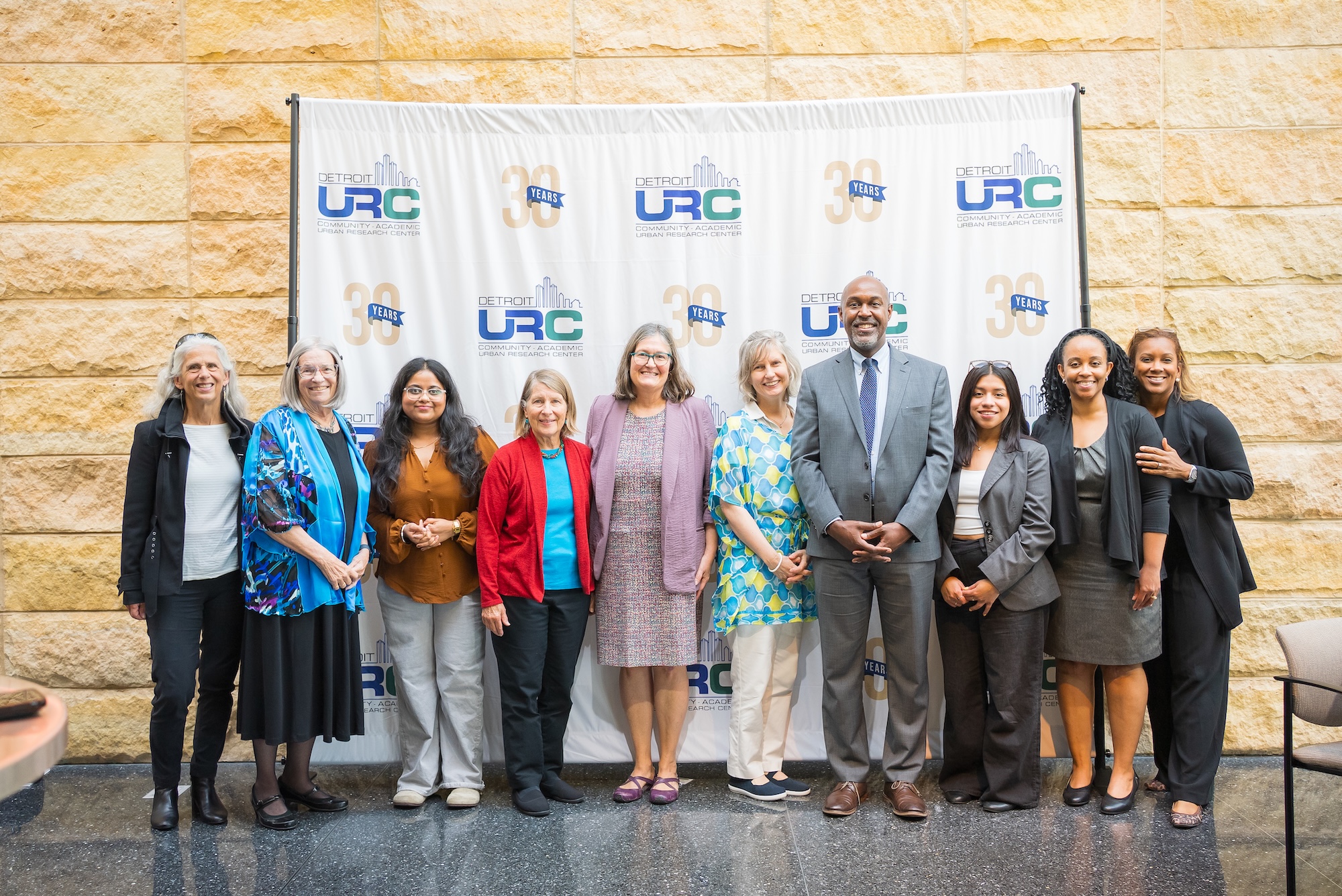
Israel and Angela Reyes, former executive director and senior adviser of the Detroit Hispanic Development Corporation and a founding board member of the Detroit URC, were honored at the 30th anniversary celebration this fall at the Federal Reserve Bank of Chicago-Detroit Branch.
The day-long Celebration & Symposium included a keynote from Rip Rapson, president of the Kresge Foundation, who reflected on the role of philanthropy and partnerships in advancing health equity in Detroit. He emphasized the importance of long-term, community-driven investment and collaboration in supporting public health and neighborhood change.
The day also included a panel of community-academic partnerships that highlighted 30 years of Detroit URC impact across the city. Another panel featuring leaders of Kresge’s Detroit Program, the Michigan Health Endowment Fund and the Skillman Foundation focused on partnerships in advancing equity and community driven research. A third panel brought together public health officers from Dearborn, Oakland County and the Detroit Health Department to discuss leading change in their own communities.
The day concluded with community conversations—a facilitated dialogue with attendees about future priorities, vision, partnership challenges, CBPR policy advocacy, emerging health issues, sustainable funding, youth engagement and honoring the legacy of the Detroit URC.
As the Detroit URC enters its fourth decade, it continues to build on a legacy of community-based participatory research, centering partnership, trust and shared leadership to address persistent health inequities in Detroit.