A new seat at the table: U-M business expert finds AI essential to collective thinking
EXPERT Q&A
How do we solve complex global problems when our traditional models can’t keep up with reality?

In their latest work, Scott Page, professor of management and operations at the University of Michigan’s Ross School of Business, and Jacob Taylor of the Brookings Institution, argue artificial intelligence is no longer just a tool to be used after a meeting—it is a participant reshaping how ideas evolve.
Page recently explained how this human-machine partnership is making global problem-solving more inclusive—and far more effective.
What is “the physics of collective intelligence”?
As we defined in the paper, this phrase refers to how ideas, drafts, data and perspectives move between people, how much information groups can process, and how quickly they can transform a collection of vague concepts and hunches into a concrete plan or policy.
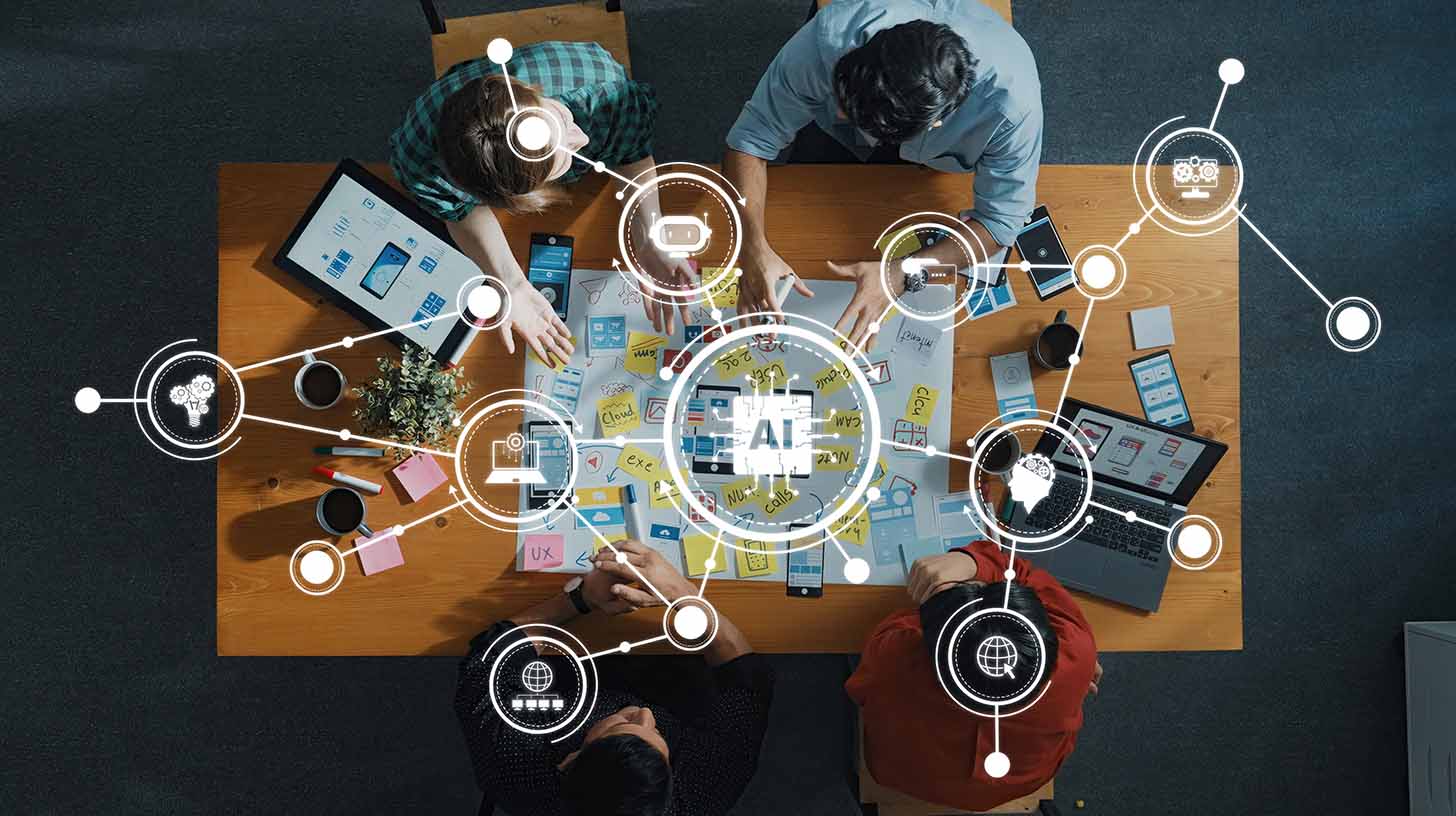
Advances in technology have altered group deliberations and decision-making in three profound ways. First, our access to information has augmented our knowledge base and made us all smarter. Second, there are AI agents with the ability to capture the granular data humans might otherwise miss. Now those agents can be part of the room, not just a tool implemented afterward.
And third, with the technology in place, we can do things simultaneously and asynchronously, giving us access to more information than was possible a few years ago.
Your piece described two different frameworks for solving complex problems. Can you explain how they work and their limitations?
The first framework is the design-minded camp. This group starts by booking a room. They focus on the “who” and the “how”—the agenda, the chemistry and the group dynamics. Their goal is to get people talking so they can walk away with a clear list of next steps.
The limitation? A room can only hold so many perspectives. Because they’re working with a small group over just a few hours or days, they often find a “good enough” solution for the people present, while remaining blind to the wider ripples and trade-offs across the whole system.
The second is the model-minded camp. They start by drawing a map. They gather data, plot causal loops and run simulations to see how variables interact.
But models have blind spots, too. They usually rely on historical or “clean” data, which misses what’s happening on the ground right now. They’re great at capturing well-defined constructs like debt, inequality or risk of flooding, but they struggle to capture the “messy middle”—the local politics, the WhatsApp chats and the gritty negotiations where the real work actually gets done.
So how could the inclusion of AI improve these methods?
Machine learning has incredible potential to summarize and categorize multiple conversations happening simultaneously. It can take enormous amounts of information and assemble it in some form that might be useful to everyone.
There are many ways to do this, and I think the real challenge will be the learning curve with any one of them. But the idea is to move toward a system where we’re collectively putting together all the ways of thinking and expertise on a specific topic.
What are the next steps?
Frameworks like this are being experimented within a variety of contexts. The idea is to move toward a system where we are collectively putting together all the ways of thinking and expertise people have, dimensions people care about, relationships between those dimensions, and then trying to think through the multidimensional implications of a policy, as opposed to just a one-dimensional outcome—like did gross domestic product increase or inequality fall.
For example, think of the 17 United Nations Sustainable Development Goals—far too many for any one person to take into account without some form of decision aid.
By using AI to amplify our understanding of the complexity of modern policy choices and the diversity of ideas and opinions, we can create a rich, shared information environment that results in a more complete, inclusive, and deliberative process.
The goal is to use these tools to sharpen our collective intelligence, not replace it.