DESI completes planned 3D map of the universe, is still exploring
The Dark Energy Spectroscopic Instrument completed its 5-year survey ahead of schedule with more data than anticipated to usher in a new era of cosmology
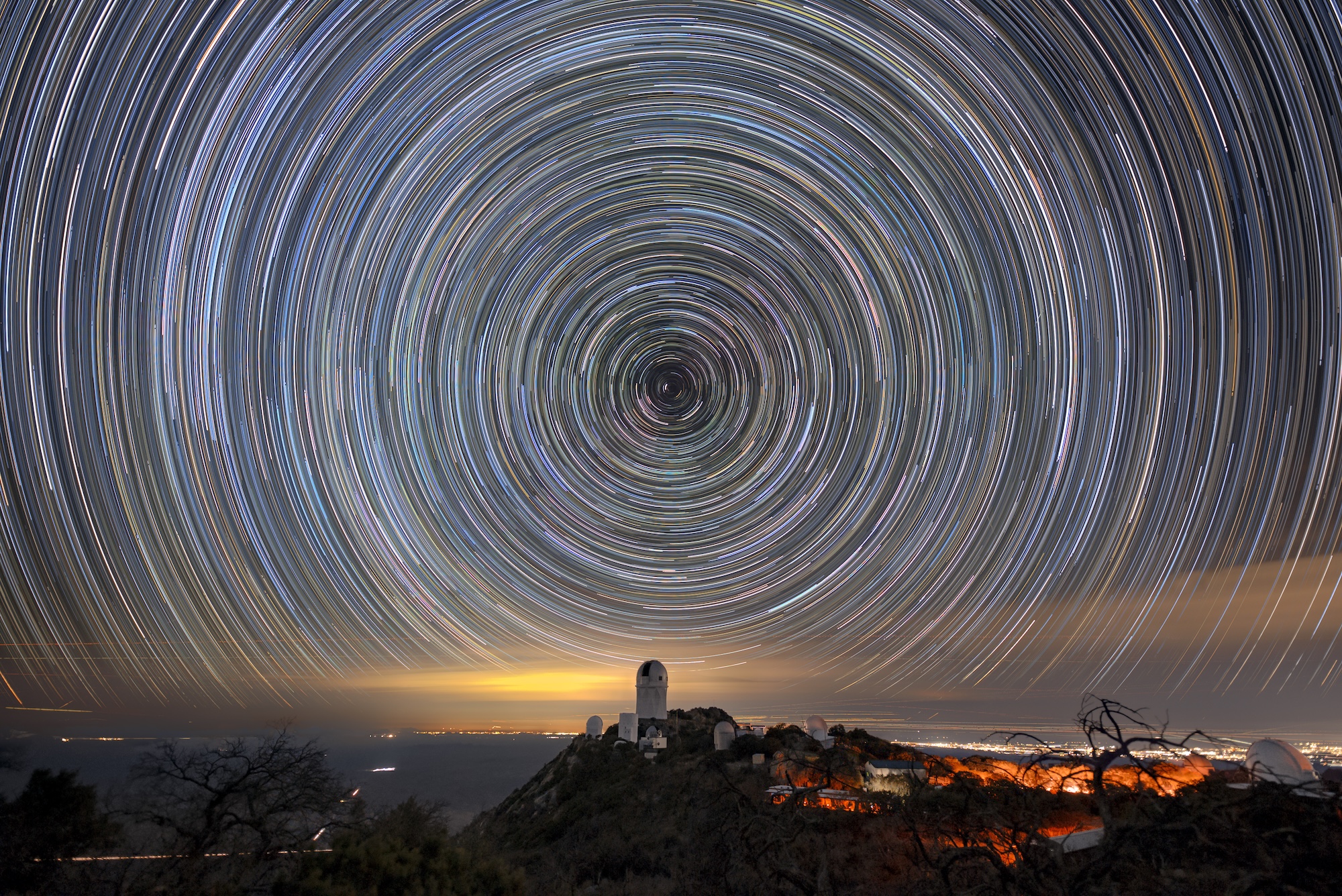
Last night (April 14), the 5,000 fiber-optic eyes of the Dark Energy Spectroscopic Instrument, or DESI, swiveled onto a patch of sky near the Little Dipper. Roughly every 20 minutes, they locked on to distant pinpricks of light, gathering photons that had traveled toward Earth for billions of years.
When the sun rose, collaborators from institutions around the world, including the University of Michigan, marked completion of a major milestone: successfully surveying all of the area in DESI’s originally planned map of the universe.
The five-year survey, finished ahead of schedule and with vastly more data than expected, has produced the largest high-resolution 3D map of the universe ever made. Researchers use that map to explore dark energy, the fundamental ingredient that makes up about 70% of our universe and is driving its accelerating expansion.
By comparing how galaxies clustered in the past with their distribution today, researchers have traced dark energy’s influence over 11 billion years of cosmic history. Surprising results using DESI’s first three years of data hinted that dark energy, once thought to be a “cosmological constant,” might be evolving over time.
With the full set of five years of data, researchers will have significantly more information to test whether that hint disappears or grows. If confirmed, it would mark a major shift in how we think about our universe and its potential fate, which hinges on the balance between matter and dark energy.

“The stunning discovery by DESI that dark energy is likely dynamic, has forced us to rethink everything we thought we understood about the nature of dark energy and its origin,” said Gregory Tarlé, U-M emeritus professor of physics. “We are now considering models of dark energy and its association with the formation of stars and black holes that were unthinkable when we first started construction.”
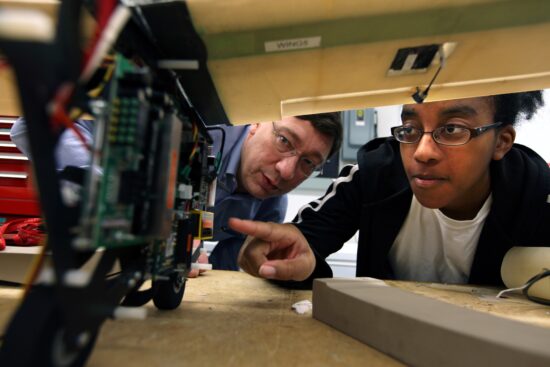
Tarlé is a founding member of DESI and what’s known as a builder, a recognition awarded to individuals for long engagement with and significant contributions to the project. Tarlé led the team that built the DESI robotic fiber-positioner system—those 5,000 fiber-optic eyes.

“DESI has been extremely successful. It has far exceeded our expectations,” said Michael Schubnell, a research scientist in the U-M Department of Physics.
He is a core member of the DESI instrument and operations team, and a DESI builder, who also helped lead the team that built the robotic positioner system. Other U-M contributors to DESI include Camille Avestruz, assistant professor of physics, and Dragan Huterer, professor of physics, who was also awarded DESI builder status.

DESI’s quest to understand dark energy is a global endeavor. The international experiment brings together the expertise of more than 900 researchers—including 300 doctoral students—from over 70 institutions. The project is managed by the Department of Energy’s Lawrence Berkeley National Laboratory, and the instrument was constructed and is operated with funding from the DOE Office of Science. DESI is mounted on the U.S. National Science Foundation’s Nicholas U. Mayall 4-meter Telescope at Kitt Peak National Observatory, a program of NSF NOIRLab, in Arizona.

“DESI is an incredible instrument and an incredibly well-functioning instrument, and that’s because it was built by scientists paying attention to each and every detail,” Schubnell said. “With every aspect, we did the very best we could.”
“The results have been incredibly exciting,” said Michael Levi, DESI director and a scientist at Berkeley Lab. “And the size and scope of the map and how quickly we’ve been able to execute is phenomenal. We’re going to celebrate completion of the original survey and then get started on the work of churning through the data, because we’re all curious about what new surprises are waiting for us.”

How students help set university, DESI apart
When the DESI project was first recruiting organizations to contribute to different parts of the project, Schubnell was hesitant to take on building the positioning system. He knew the university had the expertise to build the robotic positioners, but he wasn’t sure they could handle the scale of the project.
But his colleague and core DESI member Tarlé convinced him otherwise.
“I told him, ‘Greg, this is too big for us,’ and he said, ‘Michael, we can do anything we want to. We’re physicists,'” Schubnell said. “And, of course, Greg was right.”
Still, the selection process to contribute to DESI was competitive, with candidates from around the world and some working in industries that had more experience with large-scale production. But Schubnell thinks that U-M being a university is what made the difference.
“We ended up winning because we are a university and have an incredible resource. And that resource is students,” Schubnell said. “They really took ownership of the project. They didn’t see this as a job where you get paid by the hour. They saw it as a chance to be a part of this amazing, incredibly interesting science project.”
A group of about 20 students built 8,000 of the robotic fiber positioners—5,000 for the DESI instrument and then 3,000 to spare. For example, 1,000 of those are currently used in a test module that scientists at Berkeley Lab can use to test software improvements before deploying them to DESI.
Since DESI started its survey, dozens more early-career researchers have had a chance to be involved with the project at U-M. That includes undergraduates, graduate students and postdoctoral researchers who have contributed to hardware, software, observations, data analysis and more.
“It’s exciting for students because this isn’t a classroom lab experiment. They’re not redoing an experiment that’s been done 100 times before. There isn’t even a textbook because it hasn’t been written yet,” Schubnell said. “They’re part of something new and cutting edge. That’s what a university can provide. That’s what the University of Michigan does provide.”
The sky’s the limit
Since DESI began collecting data in May 2021, it has measured cosmological data for six times as many galaxies and quasars as all previous measurements combined. The collaboration will immediately begin processing the completed dataset, with the first dark energy results from DESI’s full five-year survey expected in 2027.
In the meantime, DESI scientists continue to analyze the survey’s first three years of data, refining dark energy measurements and producing additional results on the structure and evolution of the universe, with several papers planned later this year.
At U-M, researchers are also preparing to construct the next-generation instrument that will look to build upon DESI’s success. Its plans call for 12,000 robotic eyes, more than doubling DESI’s 5,000.
“As always, it will be bigger and better,” Schubnell said, which is not to take anything away from DESI. “What we built was the most complex instrument ever developed for a telescope at that point in time. There’s no question about it.”
And DESI’s not done. It will continue observations through 2028 and grow its map by about 20%. The extended map will cover parts of the sky that are more challenging to observe, which includes areas further to the south, where the telescope must account for peering through more of Earth’s atmosphere. The experiment will also revisit the existing area of the map to collect data from a new set of galaxies: more distant and faint “luminous red galaxies.” These will provide an even denser and more detailed map in the regions DESI has already covered, giving researchers a clearer picture of the universe’s history.
“We’ve built a remarkable piece of equipment that met all our expectations and then some,” Levi said. “Now we’re pushing beyond our original plan. We don’t know what we’ll find, but we think it’ll be pretty exciting.”
DESI is supported by the DOE Office of Science and by the National Energy Research Scientific Computing Center, a DOE Office of Science national user facility. Additional support for DESI is provided by the U.S. National Science Foundation; the Science and Technology Facilities Council of the United Kingdom; the Gordon and Betty Moore Foundation; the Heising-Simons Foundation; the French Alternative Energies and Atomic Energy Commission; the Secretariat of Science, Humanities, Technology and Innovation of Mexico; the Ministry of Science and Innovation of Spain; and by the DESI member institutions.
The DESI collaboration is honored to be permitted to conduct scientific research on I’oligam Du’ag (Kitt Peak), a mountain with particular significance to the Tohono O’odham Nation.
DOE’s Office of Science is the single largest supporter of basic research in the physical sciences in the United States, and is working to address some of the most pressing challenges of our time.
Written by Lauren Biron, Berkeley Lab