Student ventures take spotlight at Impact Venture Demo Day
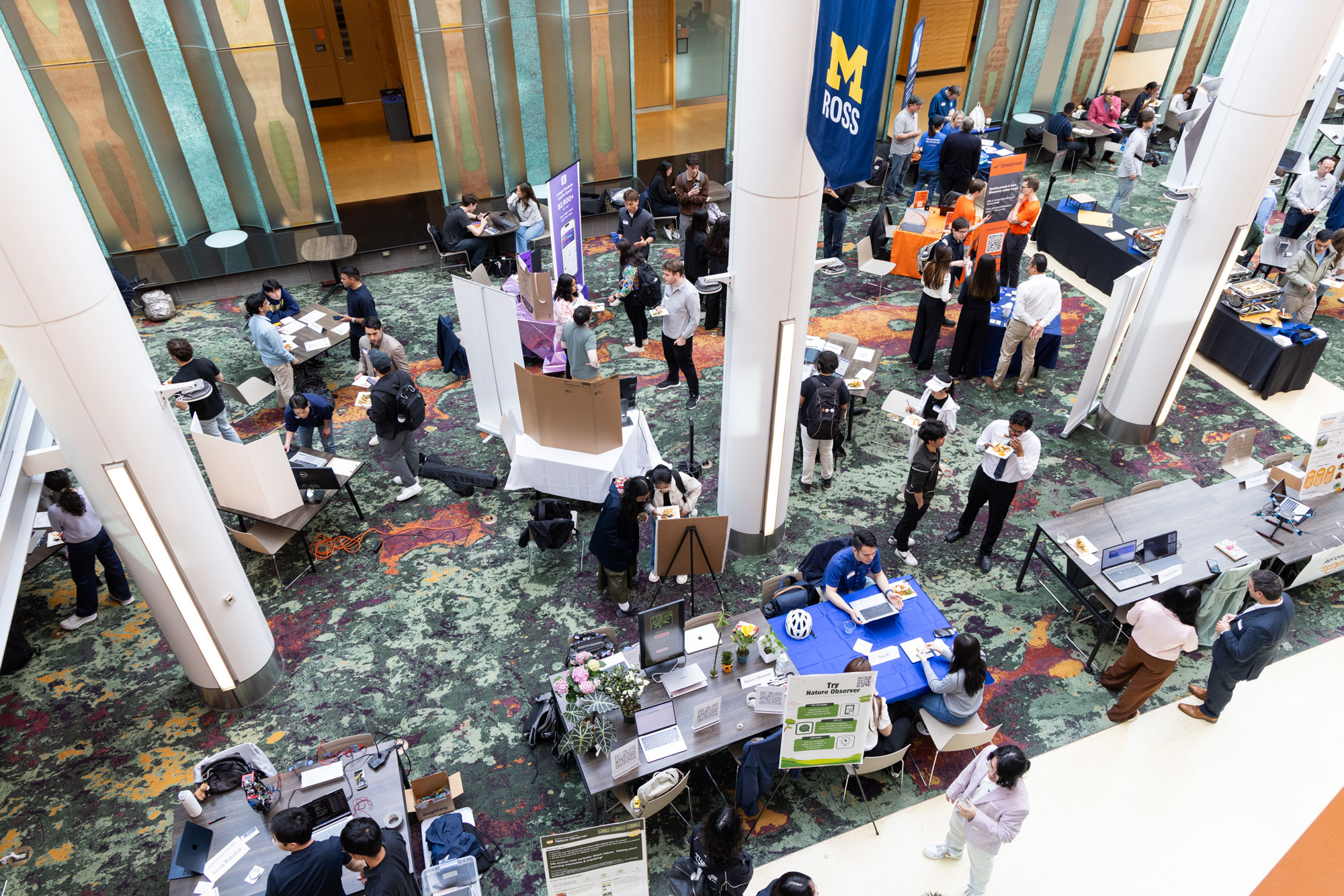
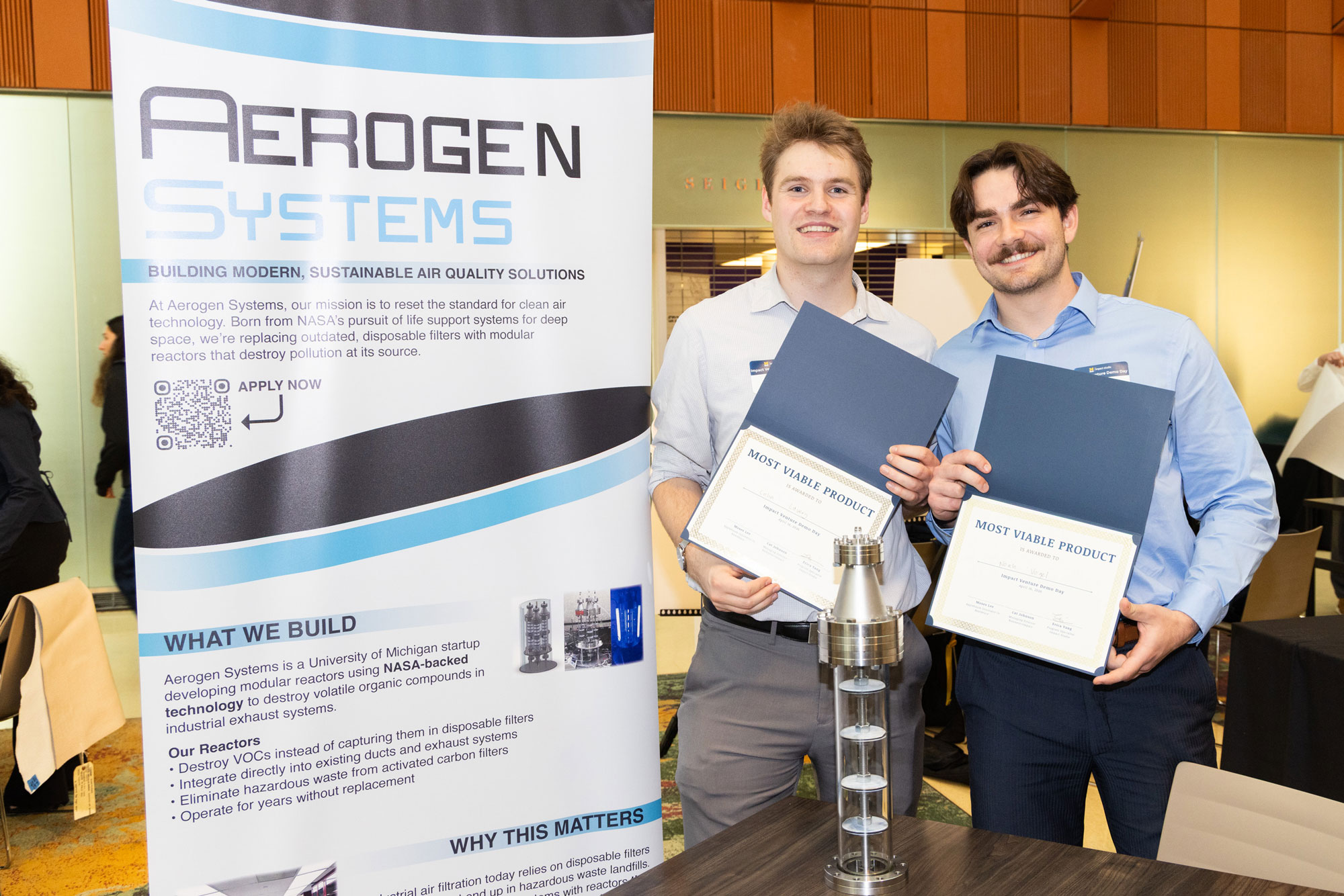
Student entrepreneurs from across the University of Michigan showcased ventures tackling global challenges at the Impact Venture Demo Day on April 16 at the Stephen M. Ross School of Business. Of the 28 enterprises, Aerogen Systems, a team from the College of Engineering aimed at improving spacecraft air quality, came out on top.
Hosted by the Ross Impact Studio, the second annual event brought together students, faculty, investors and community partners to explore early-stage ventures designed to address issues rooted in the UN Sustainable Development Goals. The ventures were presented by 34 students and recent graduates representing schools and colleges across the university, highlighting U-M’s interdisciplinary approach to entrepreneurship.
Bringing ideas to life
During the two-hour event, teams presented prototypes, demonstrations and early-stage products to attendees and judges, who moved between tables to learn about ventures and speak directly with founders.
Judge and Ross School alumnus Zachary Savas said he was impressed by the range of the students showcasing their ideas.
“I’m excited by the diversity of experiences in the room. We’ve seen computer scientists, engineers, and medical students, not just business students,” said Savas, who is president and founder of investment bank Cranbrook Partners & Co.. “Michigan does a great job of going to other colleges and sharing the value of business.”
Other judges came from community partners Boston Consulting Group, Michigan Founders Fund, Applebaum Ventures, Ann Arbor SPARK, SPARK Capital, Ingeborg Investments, and Google.
Coaching student entrepreneurs
Impact Venture Demo Day marks the culmination of the Impact Studio incubator program, which supports students building mission-driven ventures aimed at creating positive societal impact.
“The demo day is the conclusion of the time in the incubator for our students and an opportunity to really bring together the impact venture community on campus,” said Cat Johnson, managing director of the Ross Business Impact initiative, which houses the Impact Studio.
The Impact Studio provides community, coaching, mentorship and prototype funding to help early-stage founders move ideas toward implementation. The incubator, which this year accepted 29% of applicants, also connects students with industry experts, investors and ecosystem partners.
A defining feature of the program is its coaching model. Each venture cohort works with experienced industry coaches who provide ongoing feedback and mentorship as teams develop their ideas.
“There’s a lot of data on mentorship in early stages for entrepreneurs. Having someone who has gone through it, knows it and understands the science helps people stay engaged,” said Moses K. Lee, Applebaum Innovator-in-Residence at the Ross Impact Studio.
Students spend the semester developing their ideas through weekly sessions that combine mentorship, collaboration and venture-building workshops.
Putting it all together
Part of the preparation for Demo Day involves helping student founders think strategically about how to present their work and connect with potential collaborators.
“We talk with them about how to best utilize this event,” said Erica Yang, Impact Studio program specialist. “We mentor and coach them to think about what they’ll say if an investor or future mentor walks by.”
Johnson said the program was designed to fill a gap in entrepreneurship support for ventures focused specifically on impact.
“What was previously missing was really bespoke support for ventures that are aiming to have a specific societal impact,” Johnson said. “We’re bringing all of those tried-and-true methods of entrepreneurship but adding targeted coaching, expertise and tools when considering that a customer might not be the same as the beneficiary.”
In their weekly sessions at the Impact Studio, founders worked alongside coaches and Applebaum Impact Design Fellows to refine ideas, test concepts and build prototypes. The program blends structured instruction — covering topics such as customer discovery, business strategy and fundraising — with collaborative work sessions.
The event also serves as a key opportunity for students to connect with potential collaborators and supporters. Representatives from venture capital firms, nonprofit organizations, local startups and U-M entrepreneurship programs attended the event alongside students and faculty.
“Whatever we can do to help open doors and give them opportunities to be able to network and make connections, we want to give them their best chance to continue to grow,” Yang said.

Looking forward
Some student founders plan to continue working on their ventures after graduation, while others will pursue them as summer projects or side initiatives. For many students still in school, the experience positions them to compete in pitch competitions or apply to additional startup incubators.
Daniel John, a first-year medical student, developed BiliRoo — an infant sling with a back panel that filters sunlight to deliver phototherapy to jaundiced babies. The device, which John designed by drawing on his mechanical engineering background from Calvin University, allows infants to receive treatment while staying close to their parents, unlike conventional phototherapy.
“I grew up in Nepal and saw a lack of access to treatment firsthand, so I wanted to design a simple, non-electric, easy-to-use solution to treat infants who have jaundice,” John said. “I’m so grateful for Impact Studio for putting on Demo Day, and to be able to get advice and feedback from people from so many different backgrounds.”
BiliRoo is currently in clinical trials in Nigeria, with plans to launch in the U.S. in 2028. Not all Demo Day enterprises will make it out of early stages, but even when ventures do not become full-scale companies, program leaders say the experience equips students with valuable skills that extend beyond entrepreneurship.
“In entrepreneurship you’re always dealing with ambiguity and looking for opportunity,” Lee said. “The world is changing so dramatically. You need the right skillsets and the right mindset in order to create.”
For Impact Studio leaders, the event also highlights the growing energy around student entrepreneurship at U-M.
Picking a winner
After two hours of judging, Lee announced that the winning venture came from a pair from the College of Engineering: senior Noah Vogel and recent graduate Colin Lavery. The two led a team at Aerogen Systems to design a spacecraft filtration system that better captures Volatile Organic Compounds.
“The Impact Studio has allowed us to speak to people outside the business sphere,” Lavery said. “We know our current market but air quality is a problem that affects everyone and will affect our kids and their kids, too.”
Program leaders say the growing interest in mission-driven ventures reflects a broader trend among students who want to apply business tools to social and environmental challenges.
“I think for me it gives hope in a world that’s changing really fast with a lot of big problems that still need to be tackled,” Yang said.
Savas ended the evening with words of advice and encouragement for the student entrepreneurs present.
“In business, the how is as important if not more important than the what and why,” Savas said. “Stay flexible, stay passionate, and Go Blue!”