U-M men’s gymnastics title is full-circle moment for coach
Jordan Gaarenstroom was part of the storied University of Michigan’s men’s gymnastics team that captured the NCAA title twice — in 2013 and 2014. But winning the championship April 19 as a coach, he said, felt even better.
“As an athlete, you get this flood of emotion because of the physical work you just put into the meet. As a coach, though, you’re remembering the months of effort that led to that win — the countless nights lying in bed thinking about someone’s gymnastics,” he said.
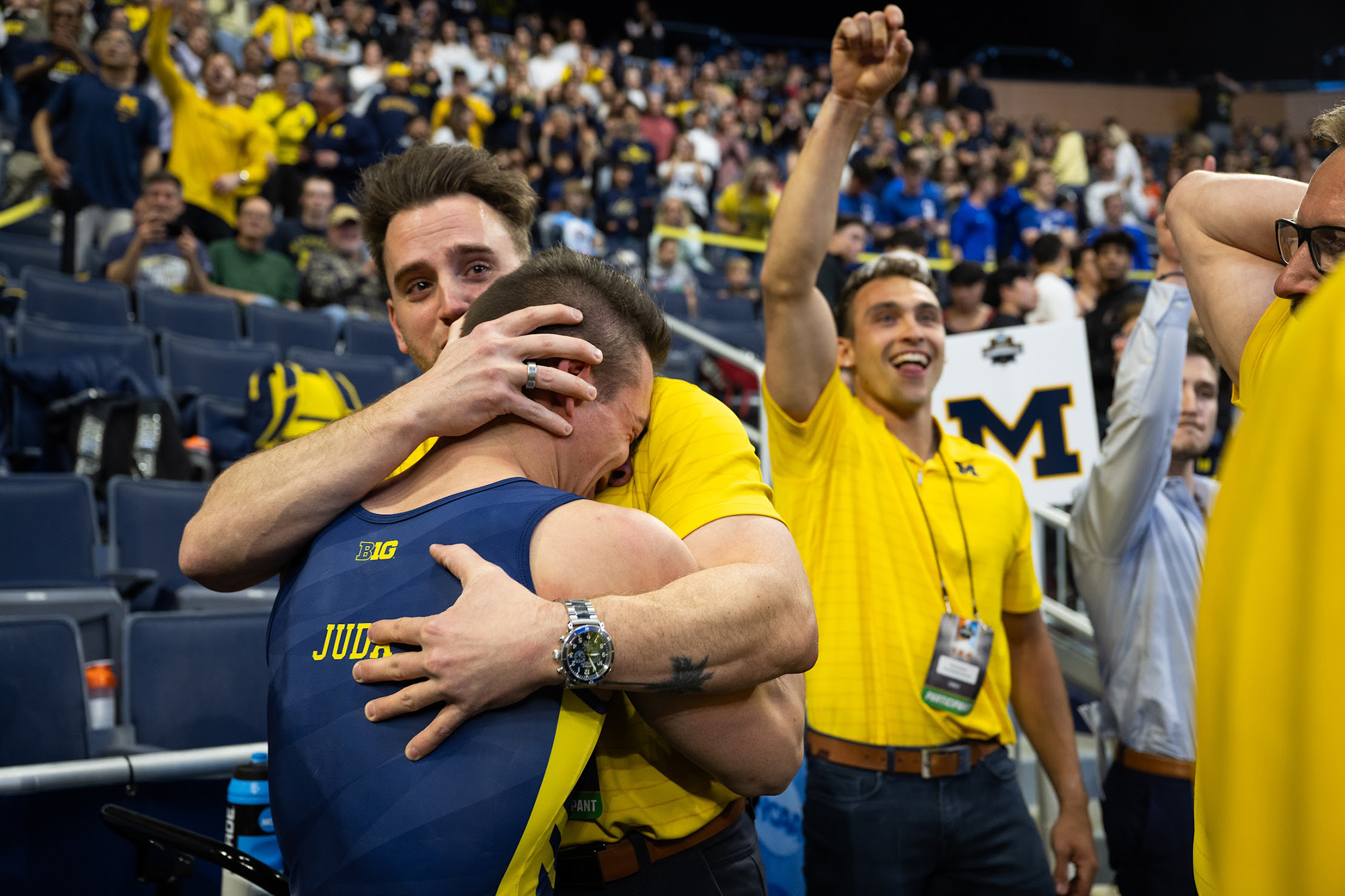
“The beautiful thing about the way we won was that it came down to Paul Juda landing in that last event on the vault. The win was fractional [Juda’s 13.966 score clinched the victory over Stanford by just 0.163 points]. And when it’s that close, as a coach, you don’t doubt that everything you did was worth doing, every effort mattered.”


An early inclination to climb
Gaarenstroom, U-M’s assistant men’s gymnastics coach, was introduced to the sport as a child in Orange County, California.
“My parents said I started walking at 9 months old, then climbed over baby gates. When I ended up on the kitchen counter every time they turned their backs, they decided gymnastics might be a good fit,” he said.
“It was love at first sight,” said Gaarenstroom of his first visit to the gym.
By age 11, Gaarenstroom had joined a competitive gymnastics training center with a new Eastern European coach who was earning a reputation for developing collegiate athletes.
At the gym, Gaarenstroom began dreaming about his college future, and he met Sam Mikulak, a future Olympian and NCAA champion, who would become Gaarenstroom’s teammate and best friend.
Becoming a Wolverine
“Sam and I would talk about being collegiate gymnasts, and, for me, Stanford was the dream,” he said.
Then they went to a competition in northern California between Stanford and U-M, and noted how much fun the U-M gymnasts were having. They decided to take a recruiting trip to Ann Arbor.
“Walking through campus on a September day, we fell in love with Michigan,” Gaarenstroom said.
They also attended a U-M football game, which made a big (house) impression.
“We saw the passion the fan base had for the school. I grew up close to USC and UCLA and had been to football games before. But I’d never seen anything like that,” he said.
As close friends, Gaarenstroom and Mikulak decided they were a package deal — and by 2009-10, Mikulak was the top gymnastics recruit in the country. Gaarenstroom was the negotiator.
“I was the one calling coaches and talking to them about what Sam and I wanted. And I had a good conversation with Kurt Golder, who was then head coach at Michigan,” he said.
After careful consideration, Gaarenstroom and Mikulak chose U-M as their new home.
Learning what it takes to win
When they arrived on campus in the fall of 2010, the U-M men’s gymnastics team had just won the NCAA Championship. Unfortunately, Gaarenstroom said they discovered this meant the remaining team had effectively “retired” and lacked the grit to go after another title. The team finished a disappointing fifth in 2011 and sixth in 2012.
On the bus ride back to the hotel after the 2012 competition, Gaarenstroom said the team huddled together.
“We vowed to do whatever we had to — more than we thought we needed to — to win the next year,” he said.
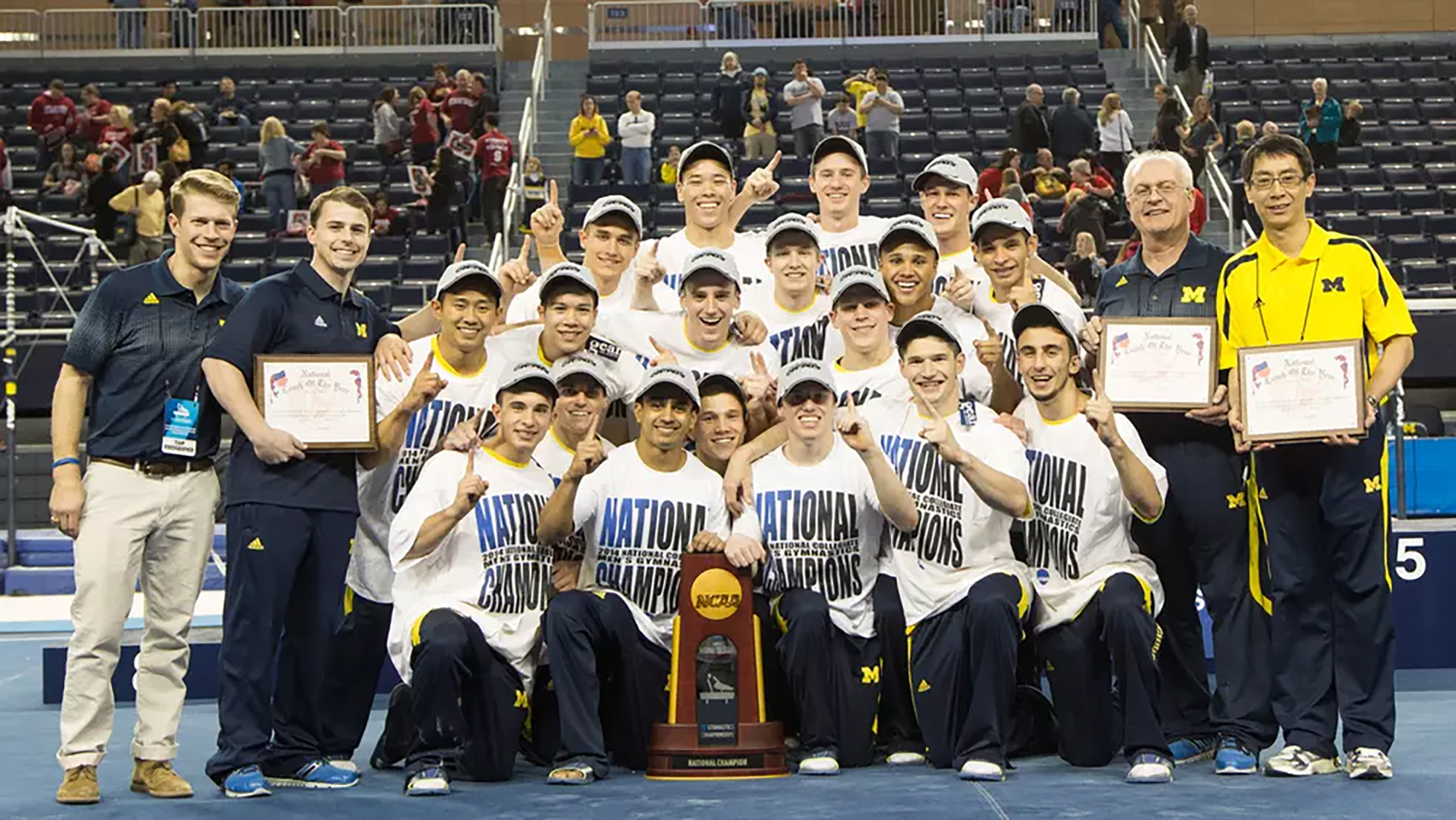
They held true to that promise and earned both the Big Ten and NCAA titles during Gaarenstroom’s junior and senior years.
Finding his calling as a coach
After graduation, Gaarenstroom started an energy-beverage business with Mikulak. Then Mikulak went to the 2016 Olympics, and Gaarenstroom found his way back to Southern California, where he began training young athletes in Huntington Beach.
“It began with coaching two hours a day, then it was three hours, then four. It became clear that not only did I enjoy coaching, I was good at it,” Gaarenstroom said.
In 2019, after seeing that an assistant coach was leaving U-M, Gaarenstroom called Golder, his former coach, to check in.
NOMINATE A SPOTLIGHT
- The weekly Spotlight features faculty and staff members at the university. To nominate a candidate, email the Record staff at [email protected].
Golder asked Gaarenstroom if he’d thought about applying for the vacant coaching role.
“I was like, ‘No, not until you just asked me that. Do you think I should?’” Gaarenstroom said. “And he told me he thought I’d be a great collegiate coach.”
So Gaarenstroom flew out from California for the interview, talked to the athletes, met with the coaches, and realized this was something he really wanted to do.
“I took the job. When I came back, Michigan had not won the Big Ten Conference or the NCAA title since I was on the team in 2014,” he said.
In the six years since his return, the team has won five Big Ten Championships in a row, and was third in the NCAA in 2021 and 2022; second in 2023 and 2024 — and last month, they finally captured the title for the first time since 2014.
Gaarenstroom has also been able to coach U-M gymnasts, including Juda and Fred Richard, when they’ve competed internationally. A highlight was joining Team USA’s coaching staff at the Paris Olympics, along with U-M head coach Yuan Xiao and Gaarenstroom’s close friends Mikulak and Syque Caesar, a former U-M teammate.
“That was a dream come true. I was coaching with two of my best friends, and four of the five Team USA coaches had ties to Michigan, which meant we had great chemistry,” he said.
That dynamic proved a winning combination as the U.S. men’s team earned the bronze medal and stood on the Olympic podium for the first time in 16 years.
Coming full circle
Back in Ann Arbor at the Crisler Center on April 19, Gaarenstroom said he was struck by the parallels between this year’s team, known as Team 81, and the team that last won it all in 2014, Team 70.
“Everything felt aligned. Both competitions were at Crisler, the fans were seated much as they’d been before, even my parents were in the same seats as 2014,” Gaarenstroom said.
And that feeling proved prescient, when the Wolverines took home the title for the first time in 11 years.
After the win, Gaarenstroom celebrated with a bottle of champagne and Team 70, most of whom returned to Ann Arbor to watch the NCAA finals.
Two days later, it was back to work — and back to the gym.
“As a coach, true success means the athletes are already calling me asking, ‘Hey, where are you? Can we work on this? Let’s do this,’” Gaarenstroom said.
As for Team 82, Gaarenstroom said its goals are clear: capture another NCAA title and tie U-M’s own Big Ten record.
“In the 1960s, U-M won the Big Ten six times in a row, so Team 82 plans to catch that,” Gaarenstroom said.
“We’re also working on sustaining our winning culture, and we’re leaning on everyone, not just the top dogs. Every athlete will need to be ready to step up.”