Music is a refuge for this professor of biological chemistry
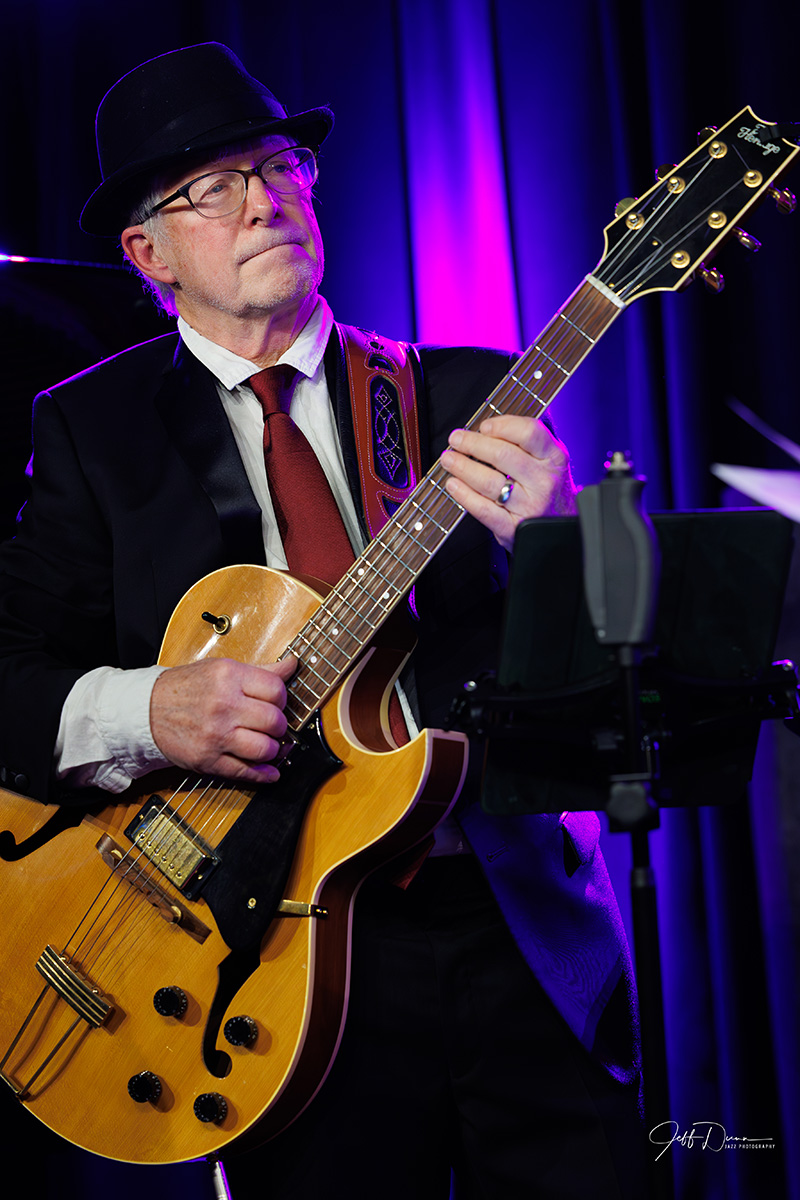
Stephen Ragsdale appreciates the healing power of music. As a child growing up in Rome, Georgia, he often turned to his piano or guitar to help process unsettling things happening around him.
In the 1960s, that meant watching civil rights confrontations on television or practicing nuclear-war drills in school.
“I often felt I had no one to talk to about it,” said Ragsdale, the David Ballou Collegiate Professor and professor of biological chemistry at the Medical School. “But I could deal with it emotionally when I turned to my music.”
Years later, on a trip to India, Ragsdale used music again as a salve. He arrived at the airport to find a chaotic scene. A traveler was yelling at a gate agent, and a crowd was forming around them. Thinking it might help diffuse the situation, Ragsdale took out his guitar and began to softly play. He walked through the crowd, which parted to allow him to pass, until he stood right next to the screaming man. The man looked over at Ragsdale, and his demeanor instantly changed.
“He smiled at me and said he loved music. Then he turned and walked away from the gate agent, immediately changing the energy in the room,” Ragsdale said.
Ragsdale, who started playing piano at the age of 7, said music has proven to be a powerful agent in many situations over the years, providing an escape, settling his mind, boosting his mood, and helping him connect to new communities.
Learning to play by ear
The first instrument Ragsdale learned to play was a green upright piano that was in his room as a child. He’d taken several piano lessons to learn to read music but decided he preferred to play by ear, emulating the music he heard on the radio or his parents’ record player.
In the beginning, Ragsdale gravitated to the black keys, saying he was drawn to their dark, melodic feel. And his parents encouraged the exploration — or at least didn’t deter it.
“I don’t remember ever being told to be quiet when I was playing around on the piano,” he said.
Both of his parents loved music and played records constantly at home.
The soundtrack of Ragsdale’s childhood ran from classical to Motown. Beethoven was a favorite, and because of its “depth and stillness,” he often listened to it as he was falling asleep at night.
When he was 12, Ragsdale took up the guitar, again preferring to play by ear. He copied what he heard — simple chords, mostly in rock and folk music. Jazz was harder. His ear couldn’t quite decode the more complex chords.
NOMINATE A SPOTLIGHT
- The weekly Spotlight features faculty and staff members at the university. To nominate a candidate, email the Record staff at [email protected].
As a teen, Ragsdale also began writing simple lyrics with chord frameworks and frequently spent lunchtime jamming in the school auditorium with Bennie Guthrie, a friend who played the organ in a local Baptist Church with a strong gospel tradition. They’d sit and play together, with Ragsdale at the piano and Guthrie on the organ.
Using music as a means of discovery
After a short first try at college, Ragsdale dropped out and hitchhiked up and down the East Coast for several years with his guitar. He busked outside gas stations, played gigs with musicians he met on the road, and landed a couple recording sessions with jazz groups in Washington, D.C. He still wasn’t reading music, but got by on ear alone.
Eventually, Ragsdale decided he wanted to go back to college to understand the inner workings of human biology, but he had little money and almost no science coursework.
To support himself and earn money for school, Ragsdale moved back to his hometown, entered the local community college and got a certificate in mechanical engineering. After working for a couple years as a draftsman and estimator at Fairbanks Manufacturing Co., he enrolled at the University of Georgia in Athens. To help pay his expenses, he found a job in a research laboratory in the Biochemistry Department. The assignment: investigate the acrosome reaction — how enzymes help sperm penetrate the egg — and, ambitiously, look for a pathway to a male contraceptive.
The work was catalytic. “I suddenly realized this is what I want to do with my life — ask questions and use science to try to solve them,” he said. He eventually earned his bachelor’s and Ph.D. in biochemistry from the University of Georgia.
Through it all, Ragsdale kept playing music — jamming with friends and gigging at local pubs — which earned him extra pocket money. After graduation, music also helped Ragsdale find community — as a postdoc in Cleveland; as an assistant professor at the University of Wisconsin, Milwaukee, where he played rock and folk in a band with other assistant professors; and at the University of Nebraska, where he played country and folk music with friends.
Getting jazzed about a new music genre
Ragdale’s first meaningful foray into jazz music began in 2007, when he moved from Lincoln to Ann Arbor to take a position at U-M’s Medical School. In Ann Arbor, Ragsdale visited the Herb David Guitar Studio, where he was introduced to Carl Michel, a jazz musician and music teacher who trained at the Berklee College of Music. Michel insisted that Ragsdale finally learn to read music. That changed everything.
“With jazz music, I’d always struggled with the notes I couldn’t quite hear,” Ragsdale said. But once he could read those chords, as well as understand jazz’s various modes, a new musical genre opened up to him — one Ragsdale now counts among his favorites.
Ragsdale worked with Michel for a decade, developing arrangements of many classic and modern jazz tunes.

Playing and performing opportunities have also been abundant in Ann Arbor. Ragsdale worked with bassist Dave Sharp in adult jazz ensembles and formed a band with other U-M scientists called The Bop Dragons. It began as an instrumental group, then Ragsdale invited Marlena Studer, a well-known local jazz singer and recording artist he’d recently met, to join them for a practice.
“Marlena immediately became part of the band,” said Ragsdale. She also, eventually, became Ragsdale’s wife.
Today, Ragsdale and Studer perform as a duo. Ragsdale has joined the Marlena Studer Jazz Ensemble, which performs at local venues like Blue Llama. Ragsdale mainly plays guitar and handles the lead sheets and arrangements.

Music, for Ragsdale, is also a practical tool for energy and focus. When he’s tired from hours of reviewing or writing papers or other academic work, he’ll pick up the guitar and improvise.
“Suddenly I’ve got all kinds of energy and I can go back to work,” he said.
Finally, Ragsdale is returning to writing lyrics. Years ago, as a graduate student, he wrote a song called “Enzyme Purification Blues,” a tongue-in-cheek lament for a stubborn protein project, and later he penned “The Greatest Thing Man Has Ever Done,” which celebrated scientific milestones.
These songs and others have been inspired by the kind of science Ragsdale loves to study — processes that make and uptake gases in our atmosphere and mechanisms that regulate human metabolism. Ragsdale’s lyrics are also inspired by the broader world, and he’s currently reworking Randy Newman’s “Louisiana 1927” to give voice to people impacted by the recent Texas floods and other environmental crises.
Although Ragdale’s taste in music has evolved over the years, the impulse behind it is unchanged.
“I just love to play,” he said.