It Happened at Michigan: Eero Saarinen left his mark on North Campus
In the early 1950s, when the University of Michigan began imagining a second campus north of the Huron River, the Board of Regents turned to Finnish-American architect Eero Saarinen to create a plan.

Saarinen, the son of another well-known architect, Eliel Saarinen, was making a name for himself as the designer behind the Gateway Arch in St Louis, the TWA Flight Center at JFK Airport, and popular midcentury modern furniture, like the Womb Chair and the Tulip Chair, both created for Knoll.
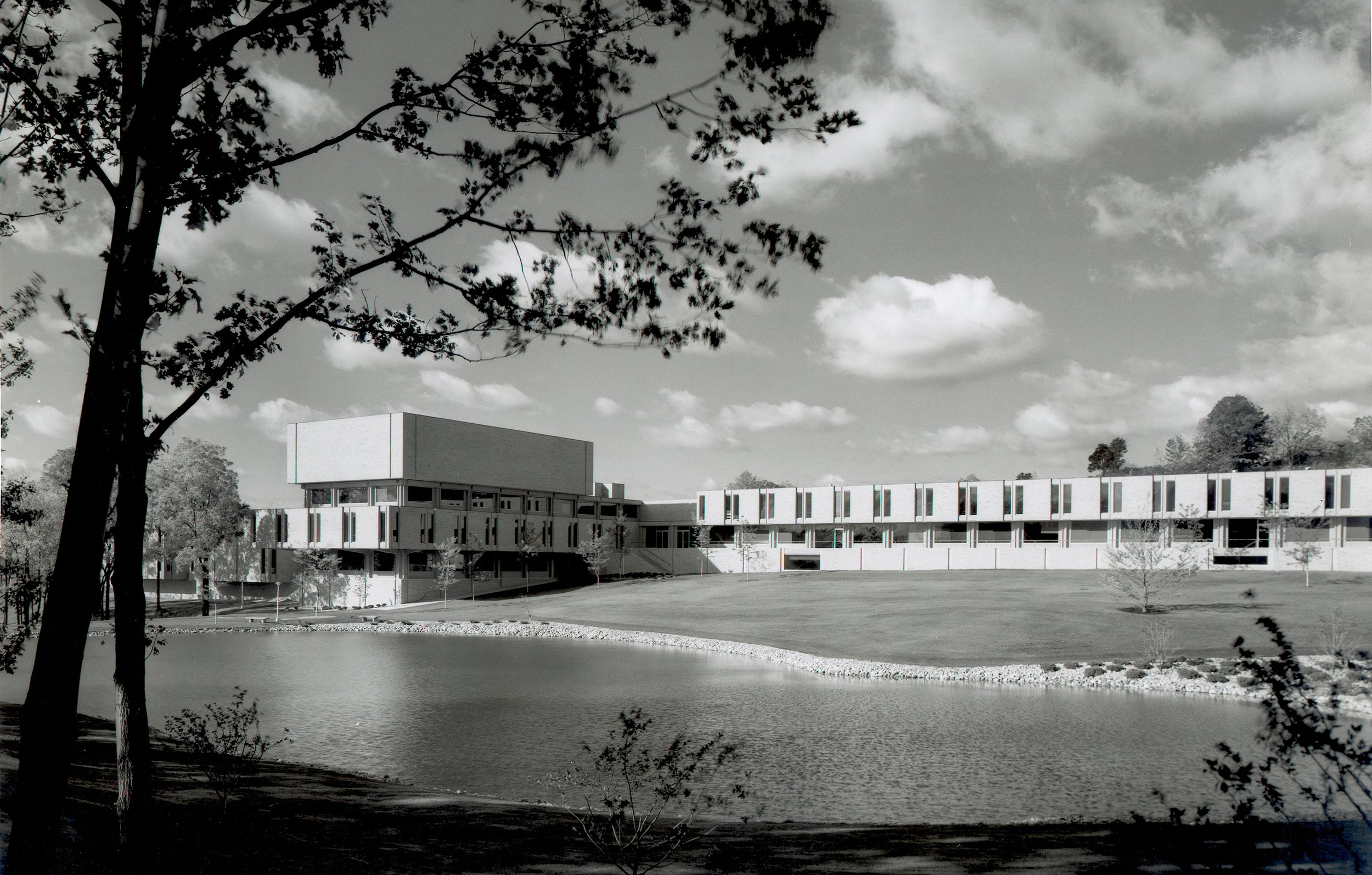
The blueprint of the new campus Saarinen sketched helped to frame what we now know as North Campus. But, due to budgetary constraints, only one Saarinen-designed building ever made it off the paper — the Earl V. Moore Building, originally named the School of Music Building, home to the university’s School of Music, Theatre & Dance.
From a distance, some say the building’s facade, with its vertical windows punctuated by long horizontal brick patterns, resembles keys on a piano. The structure is also set against wooded hills and reflected in a nearby pond, sitting in harmony with its surroundings. Whether those cues were intentional or not, the design’s purpose is indeed musical, as it houses SMTD studios, classrooms and practice spaces.
In 1975, the building was named for U-M music legend Earl V. Moore, a Michigan-trained organist and longtime music educator who earned U-M degrees in 1912 and 1914 and, beginning in 1940, served as director, then dean, of what was then the School of Music.
Sadly, Saarinen never saw some of his best-known designs come to life, including the Arch, the TWA Flight Center, and the School of Music Building. Saarinen died in 1961 of a brain tumor at 51 in University Hospital. The Gateway Arch was finished in October 1965; the TWA Flight Center opened in 1962, and work on the School of Music Building began a year after Saarinen’s death, then was dedicated on Dec. 16, 1964.
Over the years, the Earl V. Moore Building has continued to evolve, with major additions in 1985 and 2015. Today, the 143,000-square-foot facility includes rehearsal and performance spaces, studios, a music technology center, and a renowned music library that supports musicians and scholars on campus and beyond.
— By Genevieve Monsma, The University Record. Parts of this piece were adapted from “A New Breed of Architect Arrived on Campus” by James Tobin, which appeared in “Our Michigan Spaces & Places,” published by the University of Michigan Press.