How a biostatistics lecturer found her way to tribal college
Jennifer Daniels didn’t plan to study Native American history. She didn’t plan to learn beadwork or harvest wild rice from a canoe on Lake Tawas — or one day stand at an Anishinaabe language gathering in London, Ontario, following along well enough to know she was getting better.
Most of what has shaped her life, she’ll tell you, arrived sideways.
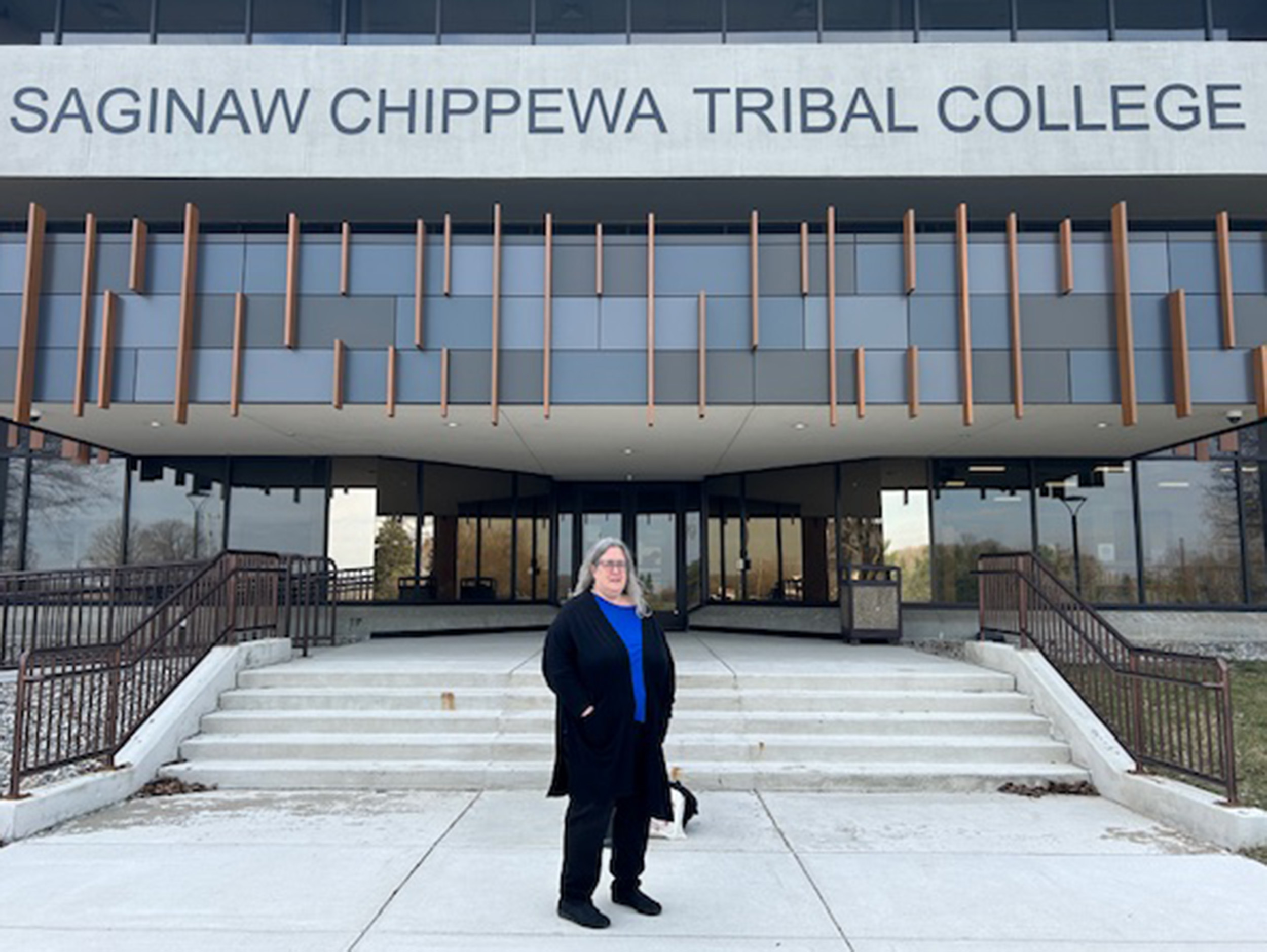
Daniels, now a lecturer III in biostatistics at the School of Public Health, was teaching math and statistics at Central Michigan University in 2010, when a student suggested she study Ojibwe. But not at CMU — at Saginaw Chippewa Tribal College, a two-year institution tucked beside the reservation in nearby Mount Pleasant. Daniels didn’t even know the institution existed.
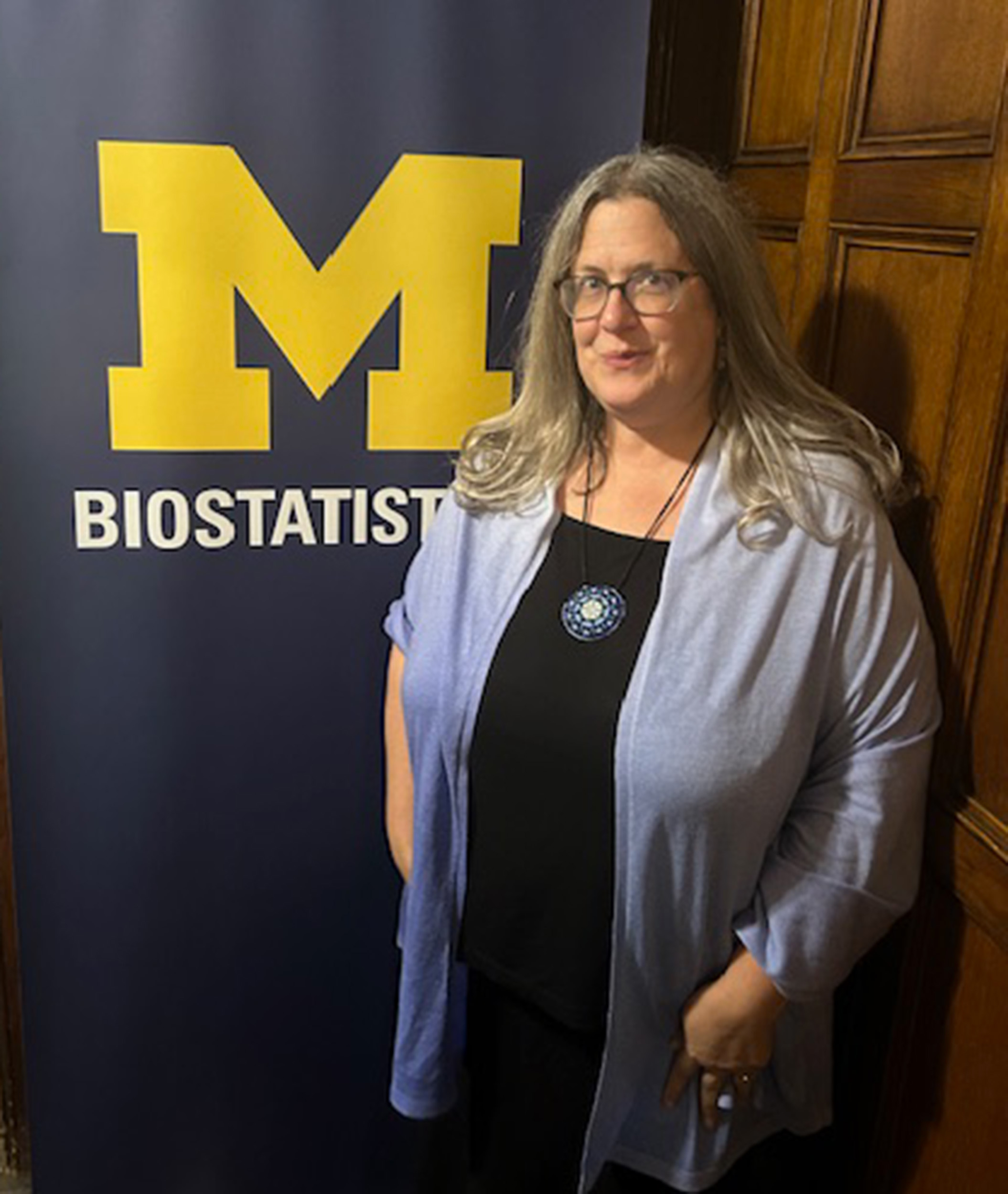
“Next thing I knew, there was an email about them needing a math teacher. I went over and met with [administrator] Carla Sinwe, and she hired me immediately,” Daniels said.
“She said, ‘Welcome to Indian country.’ That was my first exposure to the tribal college.”
A new chapter
She started taking Ojibwe. Life threw up a few detours, but Daniels finally graduated in May 2025 with a degree in Native American studies and a focus on Anishinaabemowin, the Ojibwe language.
In 2023, she joined the faculty at U-M, where she’s taught sections of biostatistics and public health since 2023, as well as met with graduate students to discuss their academic and career development plans.
She is also finishing a Ph.D. in statistics and data analytics at CMU. Her dissertation centers on a machine learning clustering tool she developed — one she has applied, among other things, to patterns in Ojibwe storytelling and data from the tribal college medicine (“mshkikiikaan”) garden.
“On the surface, biostatistics and Native American studies seem very different,” she said.
But to her, there are obvious connections. Health disparities, environmental research, land sovereignty — these are living issues in Indigenous communities, and they all require people who can work with data.
“I think it would make their environmental research so much more powerful,” she said.
A history of languages
Daniels grew up in Kalamazoo, the daughter of a German language professor and a mother with a background in foreign study advising. Languages were never just a hobby in her household.
She studied German, French, Latin and Japanese and she lived and worked in Japan for several years. When she found Ojibwe, it added something the others hadn’t.
“You can’t just translate from English into Ojibwe,” Daniels said. “You have to sort of feel the language, feel the culture.”
The language is deeply verb-oriented, active, relational — a structure that reflects a worldview where people are always in motion, always doing.
“We’re out in a canoe, we’re out collecting plants and medicine, or we’re making baskets,” Daniels said. “It’s very vibrant, very active.”
An enduring connection
That pull keeps drawing her back to the tribal college. Sometimes just to sit in the library, audit a class, or get caught up in what she affectionately calls “the vortex” — an unexpected workshop, a spontaneous outing to check on the wild rice (“manoomin”) or a corn (“mandaamin”) preparation demonstration that nobody announced ahead of time.
Her daughter Annabelle, now at Smith College, took Ojibwe alongside her, worked land grant internships in the campus garden, and competed with her mother in archery at a national tribal college student conference in South Dakota.
“It was a bonding experience for us,” Daniels said. “But she also bonded with the community. I have a lot of other women there that are watching out for my daughter and taking care of her too, which is so neat to see.”
NOMINATE A SPOTLIGHT
- The weekly Spotlight features faculty and staff members at the university. To nominate a candidate, email the Record staff at [email protected].
The Anishinaabemowin phrase Daniels returns to most often is “Mino Bimaadiziwin,” which means, roughly, following a good path or living a good life. She says it often, almost like a compass check.
It captures something she believes the tribal college embodies that traditional universities sometimes don’t: learning not for the credentials, but as a way of moving through the world together.
“There’s no stress on grades,” Daniels said. “It’s more about learning for learning’s sake. No one’s really above the other. We learn from each other.”
This philosophy has changed how she teaches. When she’s not relegated to a large lecture hall, she prefers to work through problems alongside her students rather than in front of them.
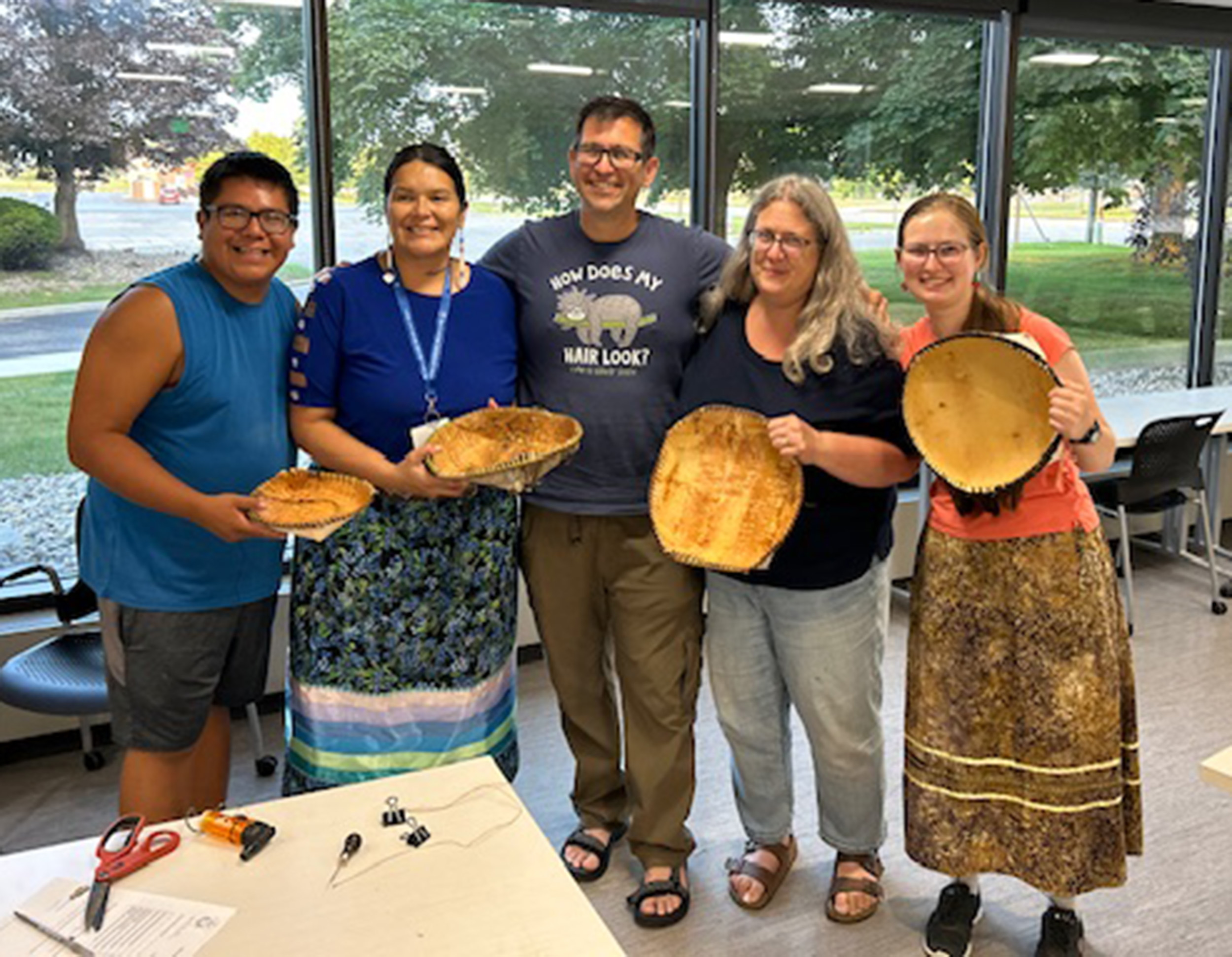
Her Ojibwe teacher, George Roy, a native speaker from Manitoulin Island who is nearly 80 and drives to campus most days, modeled something she carries with her.
“He always says, ‘I’m learning from you, and you’re learning from me,’” Daniels said.
Roy is one of the elders she speaks about with particular reverence. So is Daisy Kostus, a Cree medicine woman who has taken Daniels foraging, to a gathering of residential school survivors in Canada, to a family wedding, and across the Mackinac Bridge where they threw tobacco into the water (“Nibi”) and sang the water song together.
“They are the knowledge,” Daniels said. “Native American culture is all about storytelling. Those stories have been passed down from generations. For them to share their stories with me is just amazing. It’s such a privilege.”
A promising future
She knows the language is endangered. She sees the gaps left by the residential school system, including in her own extended family, where a great-uncle from the Sault Ste. Marie tribe never spoke Ojibwe around her growing up.
But she also sees the revival happening in real time — more students in Roy’s classes than she remembers from 2010, a language gathering that has outgrown its usual venue, a tribal college that has moved into a renovated building and is planning its first four-year degree in Native American Studies.
For anyone at U-M curious about the tribal college, Daniels said the invitation is always open. Come to the wild rice camp in the fall. Attend the powwow in the summer. Sit in on a class.
“All they have to do is call,” she said. “They’ll be welcome at any time.”