Inaugural RAxMI conference spotlights research administration expertise at U-M
More than 500 research administration professionals from across the University of Michigan gathered for the RAxMI Research Administration Conference on April 28, a first-of-its-kind convening designed to strengthen connections, share expertise and advance the profession that helps U‑M research thrive.
Centered on the theme “Renewed. United. Ready.” RAxMI recognized how dramatically the research administration landscape has shifted — from the lasting effects of the pandemic on how teams connect and collaborate to the rapid unexpected changes in the federal environment that required the community to be agile and resourceful.
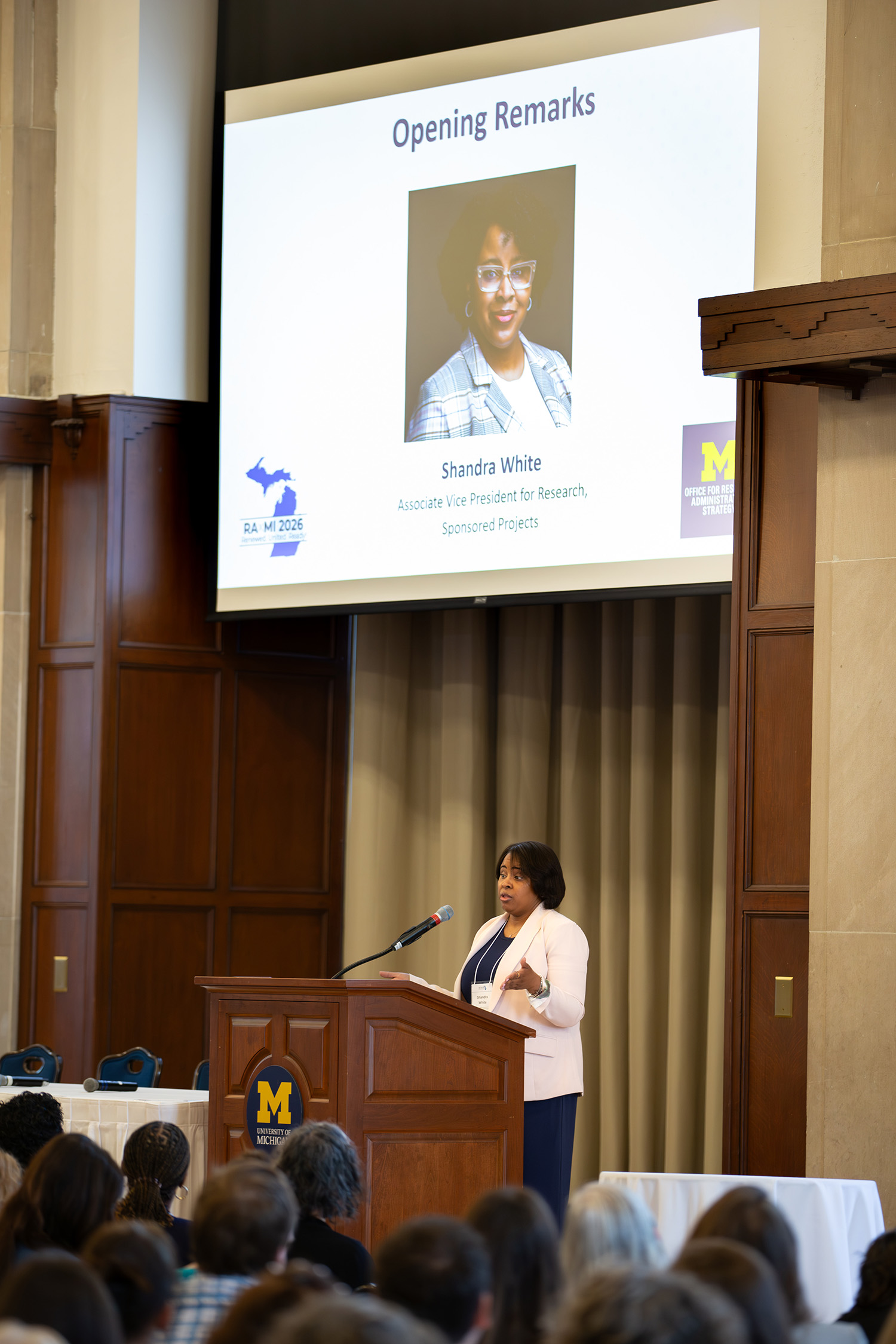
“The conference created space to move from constant reaction to long-term strategy by rebuilding camaraderie and shared practice across campuses and units, strengthening partnerships that support research, and preparing for what comes next,” said Shandra White, associate vice president for research-sponsored projects.
White delivered opening remarks along with Arthur Lupia, vice president for research and innovation.
The breadth of participation reflected the university-wide reach of the research administration community. Attendees hailed from across all three U-M campuses, representing a wide array of schools, colleges, institutes, centers and offices and range of roles spanning research administrators, program managers, financial specialists and analysts, research managers, statisticians, innovation fellows, compliance specialists, contract officers, pre-award and award management officers and many more.
Sessions and posters showcased the distributed expertise that powers U‑M’s research infrastructure.
“RAxMI demonstrated that our strength at Michigan is the expertise embedded across the university,” White said. “The sessions and posters put that knowledge on display, from compliance and international engagement to systems, metrics, and process improvement, and they created a way for us to learn from one another and scale what’s working across the university.”
The conference also featured insights from keynote speaker Brittany L. Affolter-Caine, executive director of Research Universities for Michigan, who spoke about the role of Michigan’s research universities in driving innovation and opportunity statewide.
“We are impacting the communities of Michigan, their health, their livelihoods, their kids. When we work together, we can solve big problems,” Affolter-Caine said. “Research administrators are the key enablers. [They] sit where policy, partnership and problem solving meet and are central to enabling collaboration.”
A capstone panel, moderated by Tiffany Brutus, associate director of the Office for Research Administration Strategy, explored how different nodes of the U‑M research administration ecosystem can collaborate even further to elevate research administration. ORAS, a division of the Office of the Vice President for Research, hosted the conference.
“RAxMI brought visibility in a new way to the critical role that research administration professionals have in enabling and sustaining our university’s research enterprise. As research continues to grow in complexity, the ability to align, coordinate and support these efforts becomes increasingly important,” Brutus said.
“This conference connects people, ideas and opportunities to advance that work for greater impact. Next year, we plan to expand RAxMI to include additional colleagues across Michigan universities, broadening benchmarking, knowledge-sharing and collaboration across the state.”