School of Public Health instructors bond over shared love of birds
Within minutes of meeting Geila Rajaee, you’re likely to learn she has birds, said K Rivet Amico.
Rajaee, a lecturer III in Health Management and Policy in the School of Public Health, grew up in Canton on five acres populated with peacocks. Living with a flock was a family tradition, rooted partly in Rajaee’s Iranian heritage and partly in her father’s love of birds. Today, Rajaee lives in her parents’ home, and that flock has only grown bigger.
Amico, professor of health behavior and health equity, and of global public health in the School of Public Health, also has a fondness for feathered friends. She and Rajaee bonded over their shared interest early in their relationship.
“One of the first things I noticed about Rivet was a mobile of guinea hens in her office,” Rajaee said, laughing.
By the time Amico became chair of Rajaee’s dissertation committee, birds were a fixture of their conversations, woven between methodology discussions and writing feedback. Rajaee had birds. Amico loved birds. And that began a friendship.

Peacocks, pigeons and parrots, oh my
Every morning, Rajaee lets Hero out.
Hero is an 18-year-old peacock — old enough that he no longer lives with the full flock because they’d bully him. So he gets the yard to himself, a dedicated corner of the barn, and mealworms every day.
“He’s got a little space in the barn that’s just his,” Rajaee said. “He’s very content with that.”
During the pandemic, Rajaee started incubating peacock eggs. That first year, she got eight or nine peacocks. She did it again the second year. Then, a few years later, she tried once more.
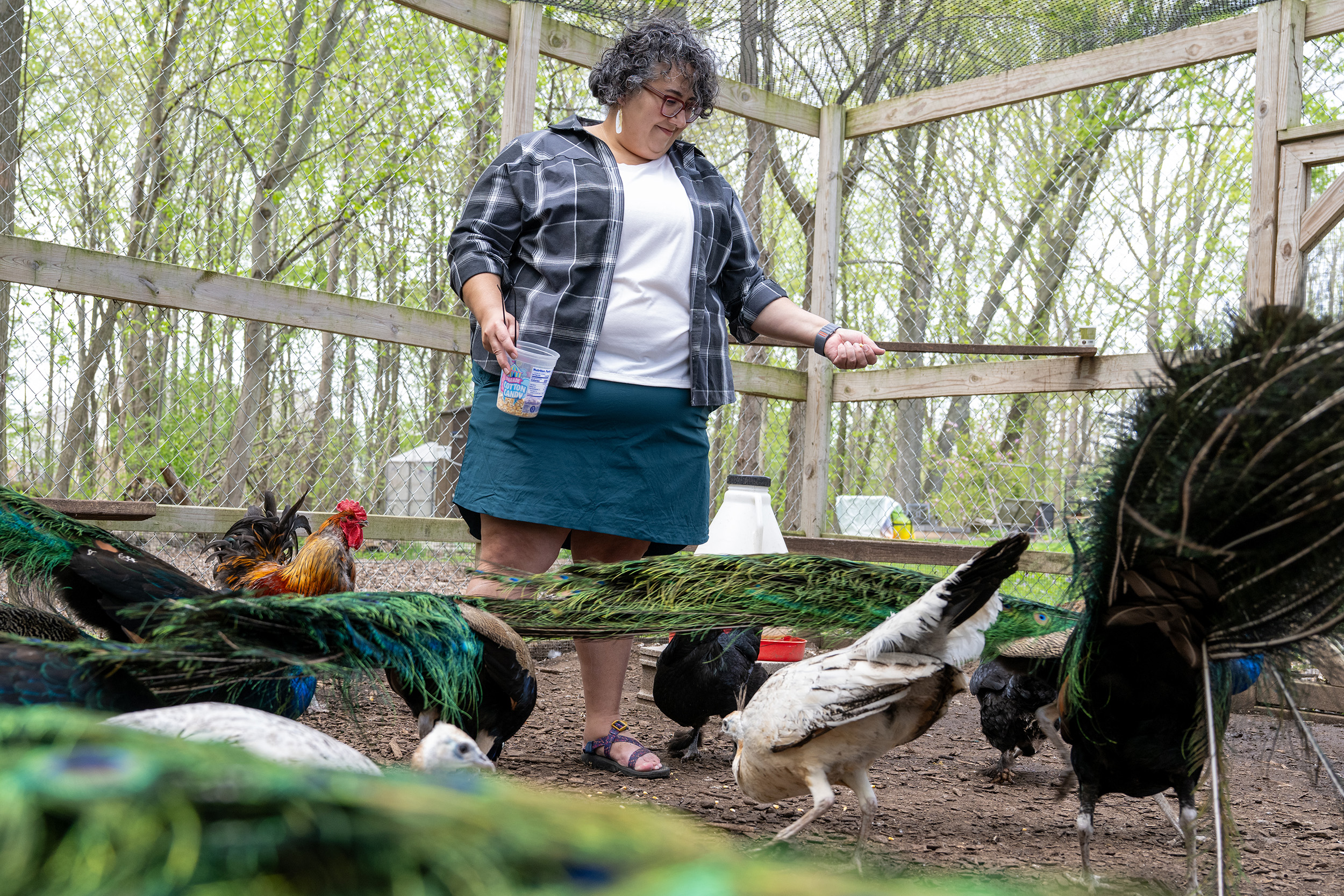
She estimates that at any given time, there are 11 chickens, eight pigeons, and an indeterminate number of peacocks (she stopped counting) roaming around outside her house. Inside, there are also two parrots: Meiko, a sun conure hatched in the mid-’90s, and Taco, a citron-crested cockatoo who figured out how to dismantle her cage within a week and how to open all the bird cage doors in the house within an hour.
“She has a lifespan of 70 years,” Rajaee said of Taco. “She’s going to outlive me.”
Rajaee’s love of birds shows up in her U-M work, too. In her Public Health 501 course, she runs a daily online attendance quiz, and the password is always a type of bird.
An accidental avian expansion
About an hour northwest of Canton, outside Brighton, Amico keeps a different kind of flock.
She moved to a 25-acre farm several years ago with her husband and two sons. The chickens were intentional. The ducks were not.
“We accidentally have ducks. We ‘on purpose’ have chickens,” Amico said.
A neighbor needed someone to take a Pekin drake. Ducks, she learned, need companions. Now she has two Pekins, a Khaki Campbell, and two recently adopted Muscovy hens.
“As soon as people figure out you have land, they say, ‘Oh, I have an animal for you!'” she said.
The benefits of caring for birds
Both women describe tending to animals as grounding.
For Amico, taking care of her chickens and ducks provides something academia rarely does.
“The chores — the slop in the buckets of water or feeding or cleaning out the coop — has an immediate result, and that’s nice because in academia we often don’t have that,” she said.
For Rajaee, the constant bird care also offers a break from the seriousness of the classroom.
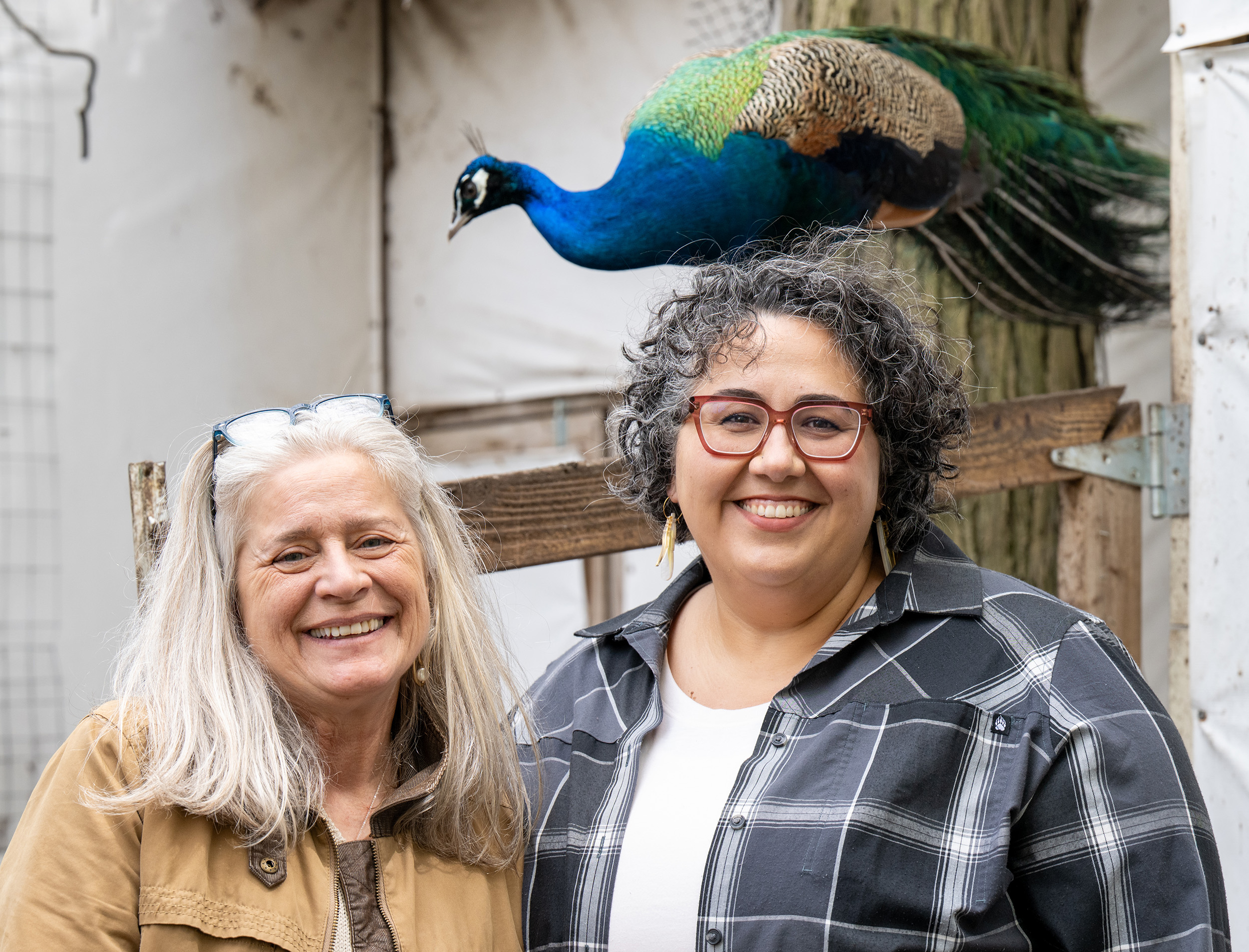
“I like being able to get out of my head for a little bit,” Rajaee said. “My creatures are weird and they do funny things, and sometimes I find myself watching them and just laughing.”
Learning to read and respond compassionately to another living being, especially when they can’t talk to you, is something both women say is a valuable skill on a farm.
One spring, Rajaee needed to move her baby peacocks across her yard twice a day. Scooping them was fastest, but they would panic if she picked them up. So, she switched to a doorless cat carrier filled with a few mealworms. She held up the carrier, let the chicks jump in, then walked them across the yard. Within a couple of weeks, they didn’t need the mealworms as bait anymore. They just knew when it was time to get moving.
Amico uses a similarly empathetic approach with her birds — and in her work. Her research centers on HIV prevention and treatment, and she works closely with communities that have historically been marginalized and misrepresented. The way she shows up at the farm, she said, is the same way she shows up in her scholarship. Not as the expert, but as a participant.
“How you show up matters. If you show up thinking you have control and it is your show, you miss all the amazing things about being a part of the process,” Amico said.
What you can learn from a duck
Rajaee came to public health after nearly a decade as a clinical healthcare chaplain in hospice, trauma and oncology. Her research now centers on whether spiritual and existential distress contributes to chronic disease risk — and whether chaplains might serve as a preventive intervention rather than last-resort care.
She remembers sitting outside an orchard near Princeton Theological Seminary, watching a duck surface and dive, surface and dive.
“There was just this moment of beauty and play in the world that I found deeply moving,” Rajaee said.
Twenty years later, it still comes back to her.
“Part of the research and the work that I’ve done — the experiences I’ve had as a healthcare chaplain — is that sometimes it’s hard to see those pieces,” Rajaee said. “It’s hard to stay connected to your body when the world is really messy and hard and ugly.”
She called it her own inoculation against spiritual distress.
“I’m really grateful for the moments to be able to stop, slow down, and watch some ducks or my peacocks jump around and be weirdos,” Rajaee said.