Taekwondo injury led to career change for U-M research fellow
HoWon Kim remembers the moment he knew something was wrong.
During a taekwondo demonstration in South Korea, he was executing a stunt known as the “human stairs” — a move Kim had practiced hundreds of times. He’d stepped across his teammates’ backs and leapt into the air, spinning and kicking. But this time, he and his team were performing in an outdoor venue without a ceiling, and Kim jumped higher than usual.

“I remember thinking, ‘Why am I still in the air?’” said Kim, a postdoctoral research fellow at the School of Kinesiology’s Performance, Rehabilitation & Injury Management through Exercise (PRIME) Lab.
Under the bright stage lights, Kim couldn’t judge where the ground was, and he landed with an extended knee. Upon impact, he heard an unmistakable pop.
“It’s a typical sound of an ACL tear,” he said.
Kim finished the routine, then hobbled backstage, where he told his teammates he was hurt. An MRI provided the diagnosis: a torn anterior cruciate ligament, or ACL.
The injury ultimately ended his taekwondo career, but it also set Kim on a path that brought him to the (PRIME) Lab, where his research now focuses on how to predict and improve outcomes after ACL injury using biomechanics, clinical neuroscience, wearable technology and neuroimaging.
Love at first kick
“In South Korea, almost all children learn taekwondo,” said Kim, who began practicing at the age of 7. He loved it immediately, especially the way he was able to chart his progress.
“I could see improvement,” he said. “I would practice one skill and see it improve. And from that skill, I could advance to the next.”
Over time, Kim gravitated to demonstration taekwondo, a performance-oriented practice that emphasizes precision, form and artistry rather than sparring. “It’s not a skill to attack people,” Kim said. “The purpose is to show how beautiful taekwondo is.”
When he was in high school, another student invited Kim to join an advanced demonstration team, and the team’s skill level impressed Kim.
“The things I had done were nothing compared to what they were doing,” he said. The gap wasn’t discouraging, but it was motivating. Kim could see new levels of mastery to chase.
Eventually, Kim chose to pursue a bachelor’s degree in taekwondo, a major offered by a small group of universities in South Korea. For Kim, it wasn’t a strategic career move so much as a way to keep training.
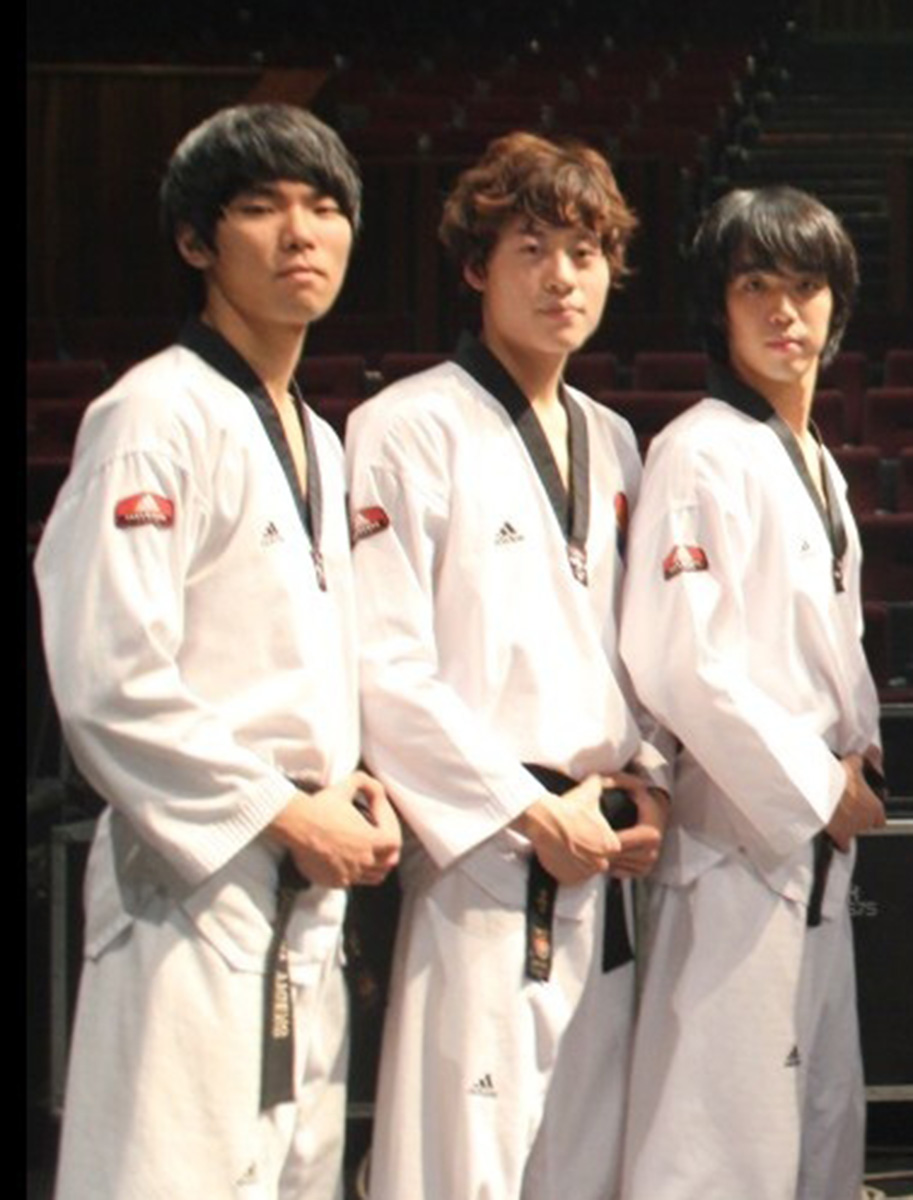
“I just wanted to keep practicing taekwondo because I really loved it,” he said.
While attending college, Kim also traveled with his advanced demonstration team, which performed in front of crowds that numbered in the thousands, including at taekwondo competitions and international events.
A new direction
Studying and performing taekwondo felt like Kim was living a dream — until it didn’t.
After tearing his ACL during his second year in college, Kim began to question his future. The injury opened his eyes to the fact that being a taekwondo performer was probably not a realistic long-term goal.
Envisioning a new path that involved helping athletes return to their sport safely after an injury, Kim left the demonstration team and took on a second major, sports medicine.
After graduating, Kim moved to the U.S., where he earned a master’s degree in athletic training at Weber State University in Utah. Along the way, he also discovered a new love: research.
To him, research felt a lot like preparing for a taekwondo demonstration. “You improve one part and keep improving, then show the new result to the world,” he said.
NOMINATE A SPOTLIGHT
- The weekly Spotlight features faculty and staff members at the university. To nominate a candidate, email the Record staff at [email protected].
Kim continued his education with a post-professional program at Ohio University, while working as a high school athletic trainer and conducting research. There, he connected with Dustin Grooms, a researcher who was studying how the central nervous system changes after musculoskeletal injuries. This was fascinating to Kim because it challenged the muscle-only focus of many rehabilitation programs.
“I never thought about how the brain might change after an injury,” he said.
The brain-body connection
Grooms’ work resonated with Kim and eventually led to his current research in the (PRIME) Lab, led by Adam Lepley. Kim’s team is studying the intersection of body mechanics and the neurophysiological role in movement.
Among the topics they are investigating is whether there are differences in brain activation after an injury that may impact performance, increase the risk of reinjury, and influence long-term outcomes — and whether those brain patterns predispose individuals to ACL injuries.
Kim’s team is also exploring the use of wearable technology with commercial devices that capture real-world movement patterns outside the lab. Kim’s team is interested in how daily physical activity after surgery may relate to recovery, brain adaptation and long-term knee health.
“What you’re doing during rehab or in the lab may not accurately reflect what your total daily activity level is,” he said.
On the topic of daily activity, Kim said he has given up taekwondo.
“I’m kind of a perfectionist,” he said. “And I know I cannot perform like I used to.”
Kim does, however, channel his martial arts mindset into his research now, using five disciplines he learned from taekwondo: respect, patience, knowing right from wrong, self-motivation, and perseverance through failure.
Research, he’s found, requires all of them, especially the last.
“I know I may not be successful at first,” he said. “But if I keep trying and trying, that can help lead to a better result.”