Students, faculty combine to raise funds, awareness for homelessness
Within a week, Brendan LaFrenier’s feet and ankles were letting him know what he had done.
LaFrenier spent part of his spring break embarking on and completing a more than 200-mile run/walk across the state of Michigan — a four-day, 99-hour journey to raise money and awareness for the homeless.
Despite months of planning, a supportive team and surprisingly cooperative weather for early March in Michigan, the trip was not without its hiccups and might have even left the 21-year-old LSA senior with an injury.
“I can only be on my feet for five, 10 minutes at a time, so it is pretty rough,” LaFrenier said. “I’ll give it another week, and if it doesn’t subside, I may have to get some X-rays on my feet.”

The pain and discomfort were worth the effort to raise tens of thousands of dollars so far for a cause LaFrenier calls “near and dear” to his heart — homelessness.
“Every time I saw someone who was battling homelessness on the street, even if they were a panhandler, growing up in Grand Rapids I would get emotional and start crying,” he said. “I remember asking my mom what is that because when I was really young I didn’t know what that was. And that opened my eyes to how blessed I was growing up and that made me want to give back.”

LaFrenier volunteered at homeless shelters as a teen and in December 2024 ran 100 miles to raise money for a nonprofit called Healing Transitions in North Carolina.
He was not terribly active on social media at the time and still managed to raise about $3,000.
“From that, I thought we could do something that could be really special and try to make a difference and try to push the needle here,” he said. “That was the seed that was planted. I think I can do something much bigger and greater for the community.”
He decided in April to start training for a 200-mile run from Lake St. Clair north of Detroit to Lake Michigan in Holland with a goal to raise $100,000 for homelessness and enlisted the support of his friend, Nick DelFranco, a 22-year-old senior majoring in film, television, and media. The pair co-founded Endurance for Change in August and partnered with 10 shelters across the state and the Michigan Coalition Against Homelessness.
DelFranco is leading the effort — with support from David Marek, associate chair of the Department of Film, Television, and Media — to create a documentary of LaFrenier’s journey across the state, with a goal of releasing the film in the fall. DelFranco said documentaries about running typically aren’t tied to a separate cause. He hopes this one “pushes the boundaries” because “it also addresses a really important topic aside from running.
“It’s fun to see filmmakers jump out of the nest and start to fly on their own that way,” Marek said.
Padrick Ritch, a lecturer III in FTVM and DelFranco’s former professor, was an early adviser and enthusiastic supporter.
“Trying to make a difference and bring awareness to an issue that they care about — that’s what you hope your students go out and do,” he said. “When you get a chance to have students work on a project that has social impact or is raising awareness, that is a great, positive thing.”
In preparation for the run that began March 2, LaFrenier and DelFranco visited the 10 shelters to meet and interview staff, volunteers and residents and explain their intention to visit each shelter while traversing the state.
“There have been a lot of people who have run an absurd amount of miles for amazing causes and raised a bunch of money, but how can we make more of a community feeling to it and really make it something unique and special?” LaFrenier said.

Those stops provided some of the most memorable moments for LaFrenier and the team he assembled. They volunteered for an hour at the first of three shelters in Detroit, distributing food and supplies, and joined some of their staff members to run to the next shelter. At the third stop, a youth shelter, they ran a “symbolic mile” around the campus with the residents, many of whom created custom bibs for the run.
“During that symbolic mile, I was talking to people who were the same age as me, brilliant people,” he said. “There was this guy who knows five languages and can play the piano and he’s an absolute genius, and he was crying and hugging me and saying thank you for doing what you’re doing.”
The crew also made stops in Ann Arbor, Lansing and Grand Rapids en route to the Lake Michigan shore. The plan was to finish the entire 200 miles and 10 stops in three days, but they ended up needing four days and three hours — “I have no shame in that,” LaFrenier said.
To date, the effort has raised over $33,000, with the fundraiser remaining open through the end of March. But more than funds, LaFrenier hopes to cast aside stigmas that surround homelessness. At the first Detroit shelter, he saw eight people wearing medical scrubs arrive there after their overnight shifts at the hospital.
“A lot of people don’t realize how close you or I are to experiencing homelessness,” he said.
The total route took them 213.6 miles that included a couple additional miles due to “navigational blips.” LaFrenier credited his team and pacers for helping him when the drive to finish was tough to find.
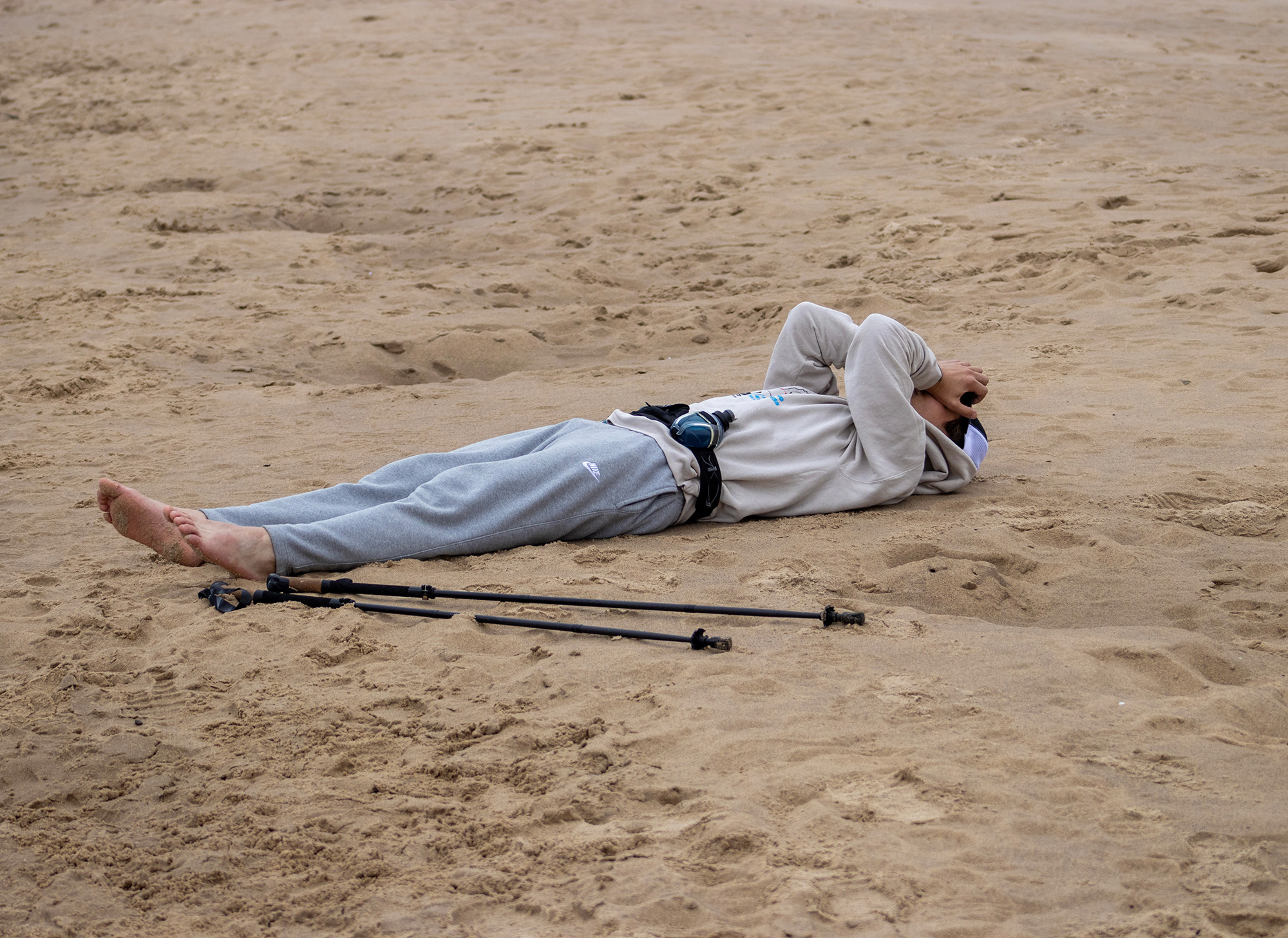
“With these ultra-marathons, something is bound to hit the fan,” he said. “You just need problem solvers. I had a crew, film team. I think the worst feeling I had was knowing I had to get up the next day and be on my feet for 15 hours. The crew would wake me up at 3:30 a.m., and I wanted to bargain with my alarm clock, and they wouldn’t allow me.
“We got to the finish line and everyone was hugging each other and shedding some tears. Finally seeing the water, we were like, ‘Oh my gosh,’ it didn’t feel real.
“Just like you can’t battle homelessness alone — you need the help from different organizations, shelters, family members, friends — you can’t run 200 miles alone.”