Student Idea Showcase spotlights student visions for U-M’s future
Ideas that focus on improving campus belonging, creating clearer pathways between the classroom and future careers, and providing AI-powered student support were among the wide range of proposals U-M students submitted to the Campus of the Future Student Idea Showcase, a winter 2026 initiative designed to elevate student perspectives on the future of U-M education.
The Showcase is part of Campus of the Future, a signature effort within U-M’s Year of Life-Changing Education theme year, which launched in August 2025. Organizers framed the program as an opportunity for students across disciplines to propose bold ideas that could improve the educational experience at U-M and inform longer-term planning.
An enthusiastic response
Interest in the initiative was high. Organizers received 734 initial idea submissions, with the largest share aligned to the Look to Michigan impact areas of Life-Changing Education (316) and Human Health & Well-Being (194). Additional submissions aligned with Energy, Climate Action, Sustainability & Environmental Equity (43), Advanced Technology (39) and Democracy, Civic & Global Engagement (24).
Students who submitted early ideas were encouraged to attend consulting and mentorship sessions with U-M staff and partners from the university’s innovation and entrepreneurship ecosystem, including:
- optiMize (LSA)
- Engaged Learning Office (School of Information)
- Center for Entrepreneurship (College of Engineering)
- Zell Lurie Institute (Stephen A. Ross School of Business)
- Center for Education, Design, Evaluation and Research (Marsal Family School of Education)
Ultimately, 41 final proposals were submitted for evaluation. A panel of 12 judges, made up of U-M staff and faculty members associated with the entrepreneurship and innovation community, scored proposals using a rubric developed specifically for the event.
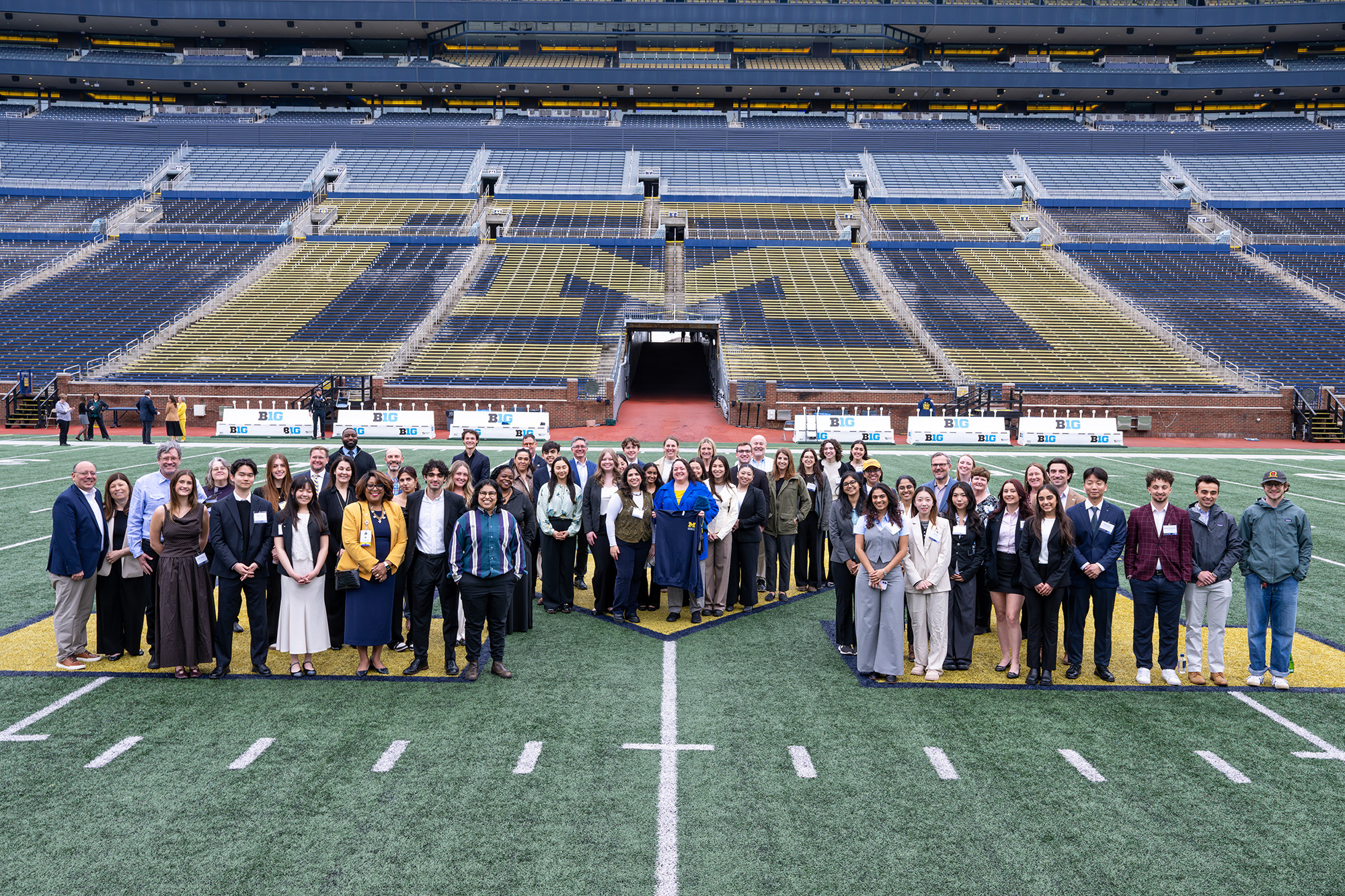
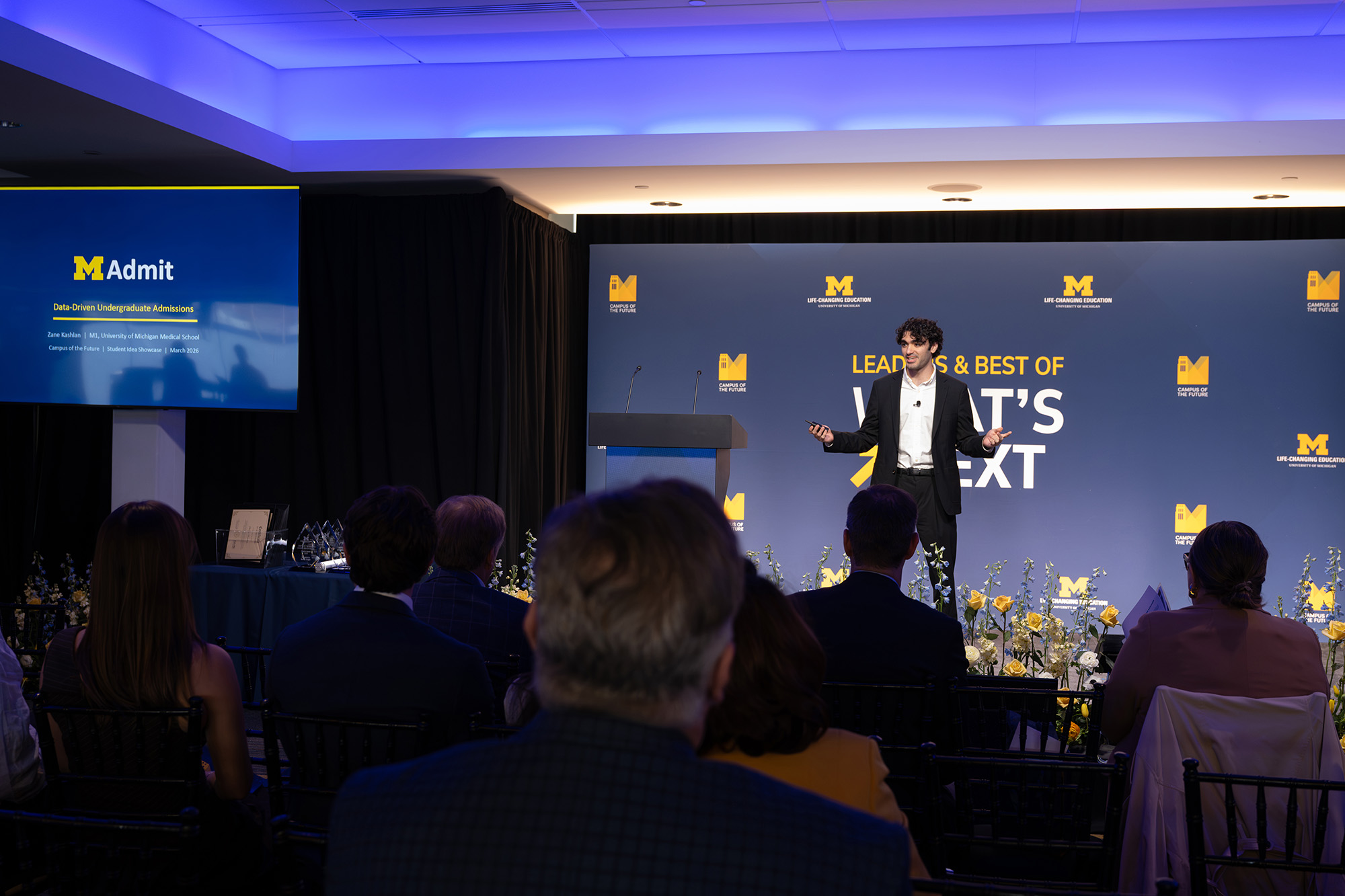
From that pool, organizers selected five top finalists to present to U-M administrators at a culminating event on April 10 at the Jack Roth Stadium Club inside Michigan Stadium. Ten semifinalists were also invited to share posters.
In remarks prior at the event on April 10, Demetri Morgan, faculty director of Life-Changing Education and associate professor of education at the Marsal Family School of Education, praised the student participants.
“Students met the moment,” Morgan said. “The ideas that brought us here today reflect their imagination, their care and a real willingness to think about how this university could become more responsive, more expansive, and more worthy of the people it serves. So, I want to say thank you to the students for helping to lead the way.”
What students want
Across the 734 initial submissions, student ideas focused on several recurring needs and opportunities.
A large share centered on AI-enabled student support that could reduce friction by consolidating scattered systems and information.
Improving campus experience issues, such as transit reliability, winter safety, food access and dining, and better study and lounge spaces, were also prominent areas of interest — as were projects aimed to create better alignment between coursework and employment after U-M.
Finally, many students focused on efforts to improve feelings of belonging and community on campus, proposing ways to reduce isolation, build peer connections and improve access to health and mental health resources.
Five finalists
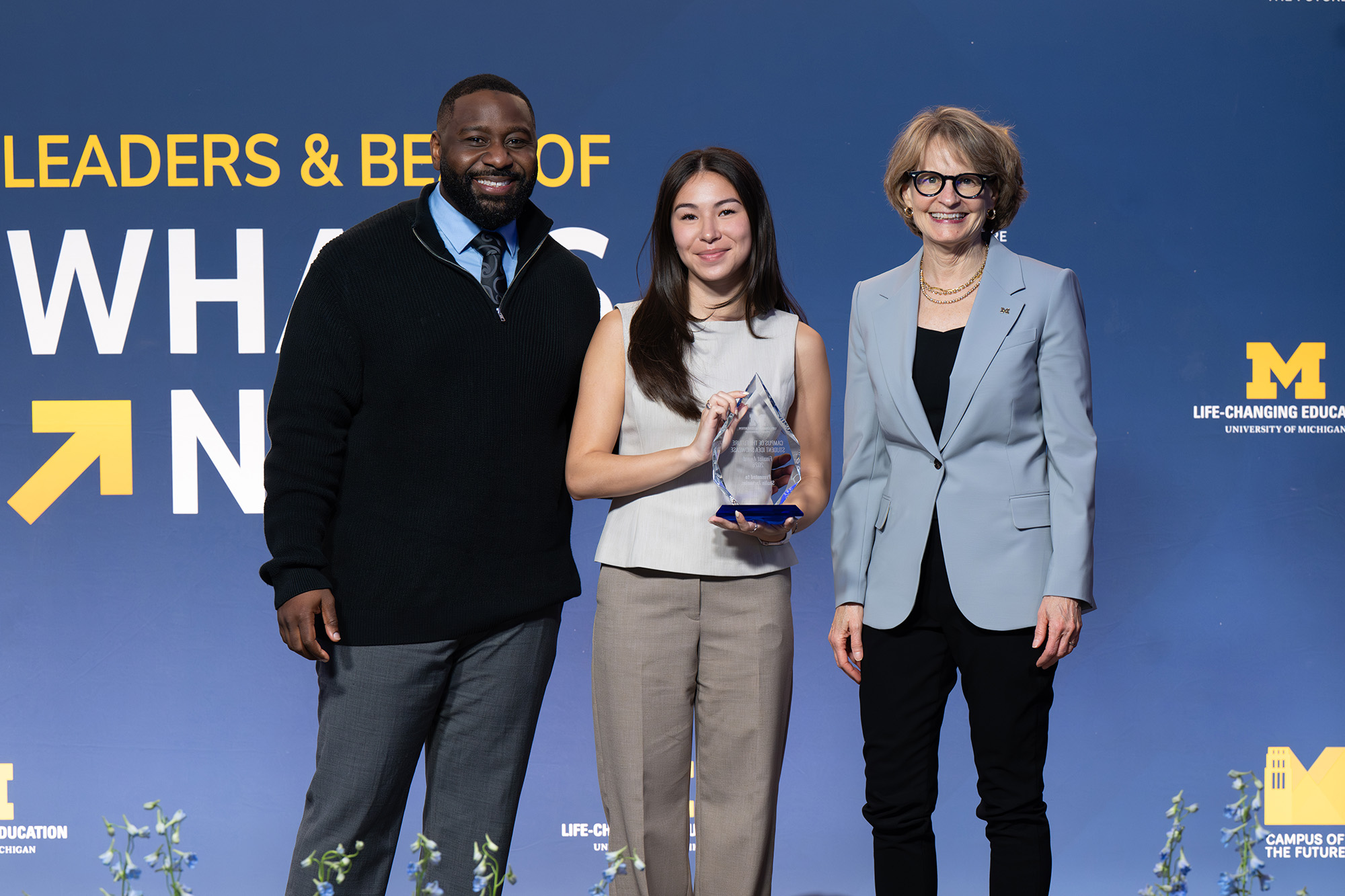
The five finalists each earned $500 and presented their ideas April 10 to U-M administrators, including Provost Laurie McCauley, University Secretary Jon Kinsey, Regent Carl J. Meyers, and Amy Homkes-Hayes, Look to Michigan executive director of strategy and implementation.
Other campus leaders who attended the event at Michigan Stadium included Angela Dillard, co-chair of the Year of Life-Changing Education, Mika LaVaque-Mant, co-chair of the Campus of the Future group, and a range of deans and department chairs.
“The ideas in the room today affirm to all of us why an ongoing commitment to partnering with students, listening to our students and creating opportunities like this is important not only for the future of Michigan, but for the future of higher education in general,” Dillard said.
“Skala: Reimagining How Students Discover, Belong, and Thrive at the University of Michigan”
Submitted by: Shalin Zarboulas, School of Information
Addressing the lack of personalized insight in the college discovery and transition process, “Skala” (stairway in Greek) would connect high school and college students through one-on-one conversations and tours. This would benefit both groups by providing informed decision-making to the high schoolers and flexible income opportunities for the U-M students.
“MinorMate: Making Minor Discovery Intuitive, Personalized, and Accessible”
Submitted by: Sophie Freyre, College of Engineering, and Michael Reifman, LSA
MinorMate would transform the discovery of minor areas of study using an AI-powered, centralized platform. By connecting students’ interests and coursework to tailored academic pathways, it could help reduce structural barriers, expand access to interdisciplinary opportunities, and support more informed decision-making. Built on existing university infrastructure, it is a scalable, cost-effective solution that strengthens academic support systems and student outcomes.
“Michigan in Motion: Walking and Biking-Centered Experiential Learning”
Submitted by: Vivian Nguyen, Kaitlyn Dodgen, Sam Galvan and Dreama Rhodes, Marsal School
This experiential learning program would aim to boost student engagement by fostering meaningful relationships among U-M students and neighboring communities. Through research-informed, themed tours in Ann Arbor and surrounding areas, students will explore local histories, civic challenges, art, and community-driven problem-solving. The tours would be offered in accessible, multimodal formats (e.g., walking, rolling, biking, and transit).
“Identity Beyond the Checkbox”
Submitted by: Samantha Cellar, LSA, and Devan Safford, Marsal School
This project proposes creating an informal system where students can voluntarily share identities that are most meaningful to them, beyond traditional institutional data categories. Drawing on ecological validation research, findings show that students define identity in diverse, personal, and context-dependent ways. This dataset would allow identities to be dynamic and student-defined, helping foster connection, support, and opportunity across campus.
“Mich Admit”
Submitted by: Zane Kashlan, Michigan Medical School
Thousands of high school students apply to U-M with almost no reliable way of knowing if they belong here. Low-income and first-generation applicants are most likely to self-select out. “Mich Admit” would offer a transparent, data-driven admissions layer that gives prospective students evidence-based guidance on where they stand, while also giving U-M better tools to identify and recruit talented students who would otherwise be overlooked.
The 10 semifinalist posters showcased additional ideas ranging from accessible onboarding for blind and low-vision riders for autonomous shuttle systems to creating a bereavement support infrastructure to programming that improves financial literacy for all U-M students.
What happens next
The Office of the Vice Provost for Undergraduate Education is offering to connect with finalists about pursuing their ideas and will act as a conduit to support across other campus units.
In addition, the Stephen A. Ross School of Business and the Marsal Family School of Education are reviewing a proposal for a course that could be taught next fall, giving students a structured pathway to build on the submissions developed through the Student Ideas Showcase.