Faculty leaders from Michigan public universities meet with state lawmakers
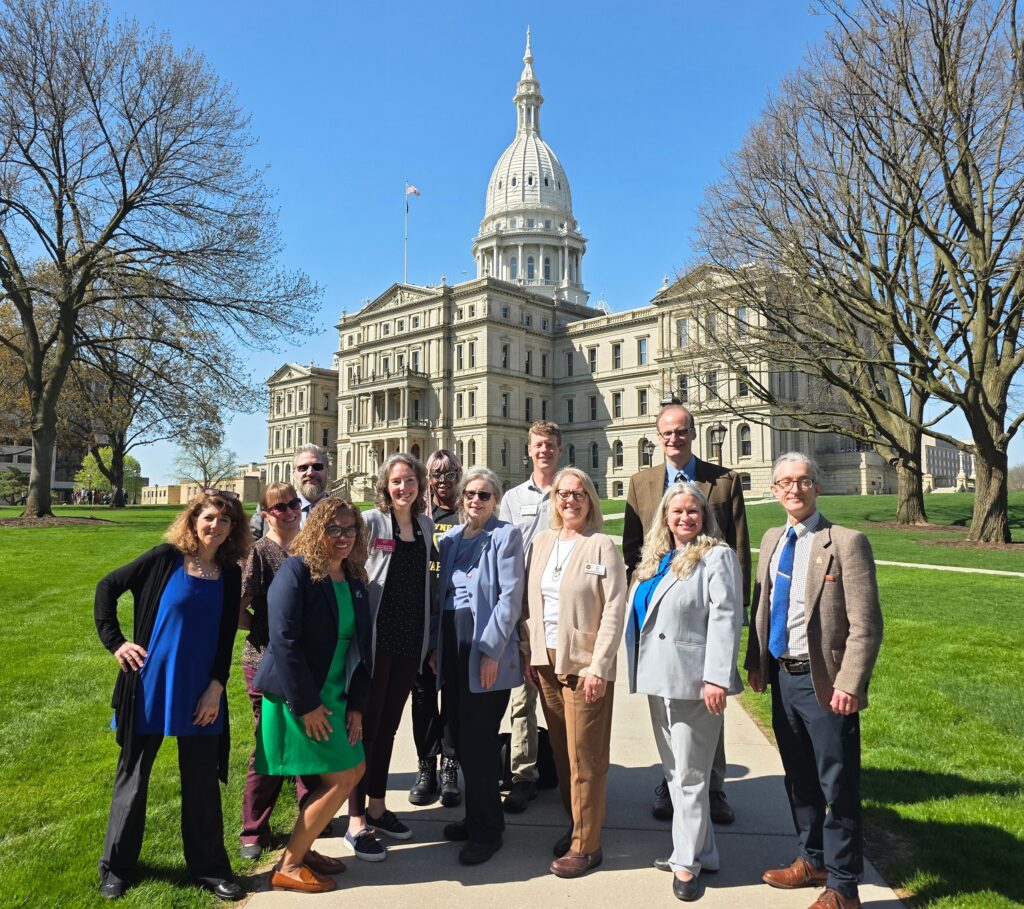
Faculty government leaders from nine of Michigan’s 15 public universities gathered April 23 in Lansing to talk to Rep. Nancy DeBoer, chair of the House Education and Workforce Committee, and Sen. Sarah Anthony, chair of the Senate Appropriations Committee, about challenges facing higher education in the state.
The discussion focused on three areas: the need for increased state investment to help address aging campus infrastructure, the role public universities play in preparing Michigan’s workforce, and the importance of academic freedom in advancing teaching, research and public service.
“This is the first time in Michigan’s history that we’ve done something like this, and I was glad to have played a role in organizing it,” said Derek Peterson, U-M’s faculty senate chair. “I think it’s important that we, the faculty, figure out how to explain what we do to the citizens and the leaders of this state. We are the people in the classrooms, talking day to day with students facing immense financial pressure. We’re in the laboratories, trying to do important research with increasingly scarce funding.
“We can’t leave lobbying to the professional lobbyists. It’s our experience and our knowledge that fuels higher education in Michigan. We have to make all of that work legible, so that legislators and citizens can see why higher education is worth supporting.”
During their discussion, faculty leaders noted that Michigan ranks 43rd out of the 50 states in higher education funding per capita. In 1979, they said, the state provided 70% of Michigan public universities’ operating resources. Today, students and families provide 78% of institutional operating dollars, while 22% of base operating revenues come from the state.
Those figures, faculty leaders said, have direct consequences for students — and the classrooms where they learn. Faculty described students who are taking on more debt and working long hours in low-wage jobs while trying to keep up academically. They also pointed to aging infrastructure, such as outdated air-handling systems and leaky windows, that make laboratory research more difficult.
“We talk to students, and we learn that it is harder to be a student,” said Janet Hahn, president-elect of the senate at Western Michigan University. “We know they are working more, they are worn down by their obligations. They need more support.”
The connection between higher education and the state’s workforce needs was also emphasized, with faculty leaders noting that many of Michigan’s most in-demand jobs require a bachelor’s degree and that universities serve a broader civic purpose.
“Having a better educated citizenry benefits all of us,” said Courtney Karasinski, faculty senate chair at Grand Valley State University.
The meeting was organized by faculty government leaders at Michigan State University, the University of Michigan and Wayne State University. They were joined by colleagues from Central Michigan University, Western Michigan University, UM-Dearborn, Oakland University, Grand Valley State University and UM-Flint. Faculty leaders from Ferris State University and Eastern Michigan University also were involved in preparatory discussions.
The group intends to continue meeting to represent faculty perspectives on higher education in Michigan.