Dining director helps students, one etiquette class at a time
When Keith Soster joined University of Michigan more than two decades ago as director of catering, he quickly noted that some of the student staff didn’t know the basics of formal service.

“The students who serve during professional dinners at the Michigan League or Michigan Union must understand how to conduct themselves, and I wanted to help them shine,” said Soster, who is now the director of student engagement and sustainability in Michigan Dining.
To get them up to speed, Soster created a simple training session. He set up a table with eight chairs, then had eight students sit down while the others acted as servers. Together, they reviewed basic etiquette practices, such as serving to the left and clearing to the right — and for those seated at the table, passing the bread basket from left to right and not touching anything on their plate until the host has picked up their napkin and placed it in their lap.
One student staffer learned so much at that session she asked Soster if he would present to her sorority.
He accepted and suggested they do the presentation while the women ate dinner.
“That turned the session into a lab, where it’s OK to make mistakes and laugh. It’s all in good fun and everyone’s learning,” he said.
After that, word spread quickly, and a wide variety of organizations began inviting Soster to host etiquette workshops.
Today, Soster teaches about 20 etiquette sessions a year, both on campus and off. His audiences range from middle school hockey players to U-M student organizations to graduate students preparing for academic conferences. Topics at the workshops range from proper dining practices to networking tips.
Learning by doing
Soster’s etiquette sessions run about 90 minutes — or the typical length of a three-course meal, including salad, entrée and dessert.
At the table, Soster demonstrates how to pass dishes, how to place silverware when resting or finished, and how to use soup spoons. One of his favorite props is a giant spoon his children once bought him as a gag gift. Holding it up for the class, Soster teaches the proper way to eat with a spoon.
“You go out to sea, then back to me. That way, when you reach the back of the bowl, any drips stay there and don’t land on your shirt,” Soster said.
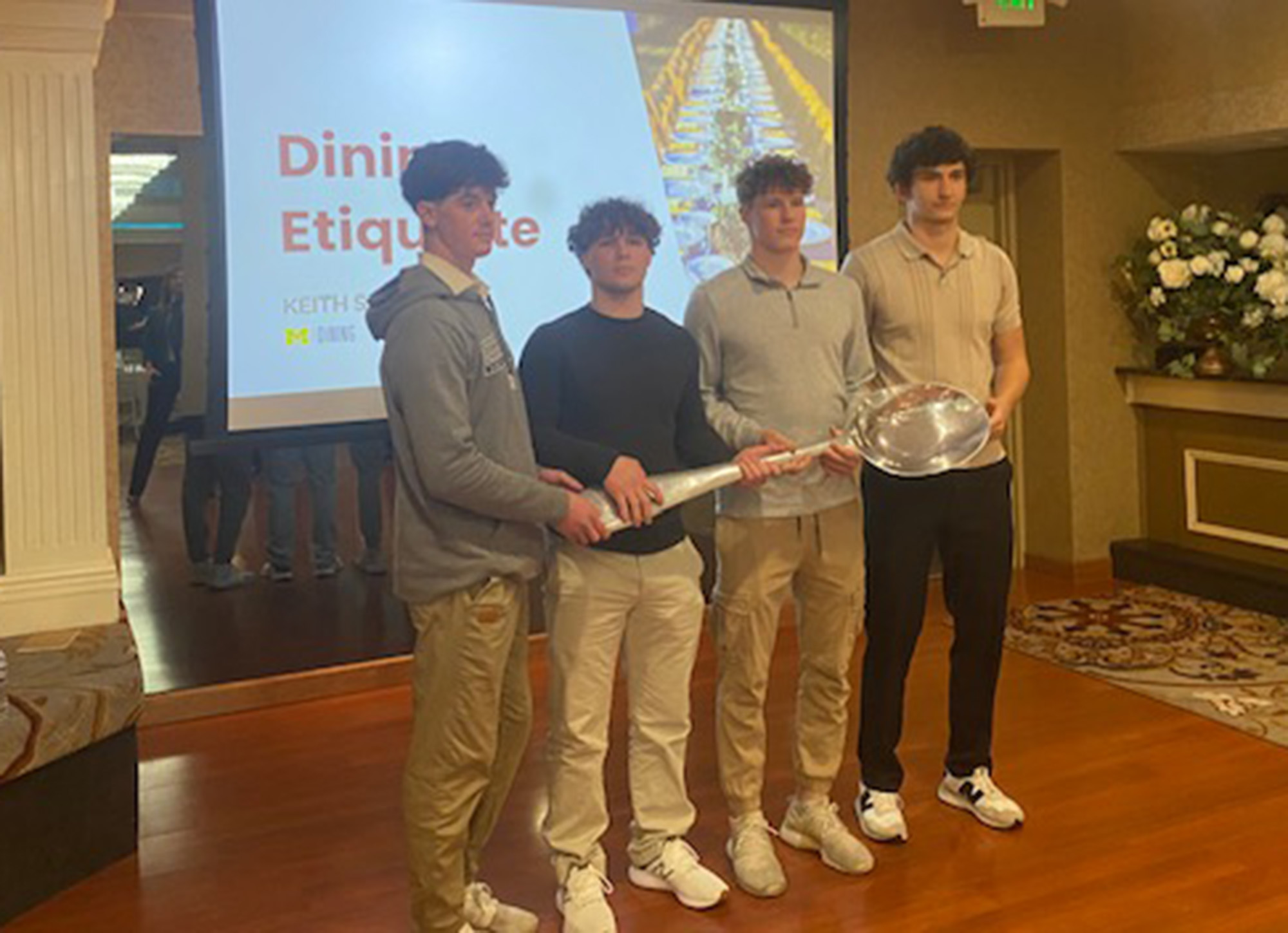
Soster’s delivery often gets a laugh, and the lessons stick in part because he sprinkles in humorous stories, like the time he left a dinner party only to have his wife inform him that he’d had parsley stuck in his teeth for hours. That incident led to a family “code” phrase — “Did you hear Madonna’s latest song?” — to discreetly signal to check for food in your teeth.
“By the way, Madonna’s newest song happens to be ‘Gone, Gone, Gone,’” Soster said. “Which is what I hoped for with that parsley.”
Soster also likes to share the story of a wedding guest who was unfamiliar with family-style meals and mistook a pasta platter for her personal entrée.
“She got about halfway through and then the server brought the next course,” he said. “She realized what she’d done and excused herself. We never saw her again,” Soster said.
“But afterward, I thought, that was on all of us at the table. There could have been a gracious way for someone next to her to say, ‘I think that’s communal.’”
These stories, he says, help students see that etiquette is less about memorizing rules and more about recovering gracefully.
Respecting cultural traditions
While most of Soster’s workshops focus on American dining customs, he said it’s important to note that etiquette can differ between cultures. “And when in Rome, do as the Romans do,” he likes to remind students.

Recently, Soster has collaborated with international students to develop an Asian etiquette workshop that incorporates Chinese, Japanese and Korean traditions. Soster also invited several U-M faculty members from the language departments to record greetings and expressions in different languages, so students can practice saying them correctly.
These sessions highlight a variety of cultural differences, including how to properly serve yourself from a rotating tray and chopstick etiquette — like never leaving chopsticks upright in a bowl of rice or placing used chopsticks directly on the table.
Soster also tells his students it’s respectful to try to understand and adopt the customs of your host — but it’s OK to make mistakes. Just own them and apologize.
“I was once at the Blue Nile, an Ethiopian restaurant in town,” he said. “And in Ethiopian culture, you don’t take food, it’s given to you. But, not knowing that at the time, I helped myself to what was in front of me. Later, I realized I’d done it wrong and reached out to my host and apologized. Even I’m still learning.”
A parallel path
In addition to imparting etiquette wisdom, Soster fosters student growth at Michigan Dining, where he oversees sustainability and student partnership initiatives.
“I’ve always been a sustainability geek,” he said. “My grandparents grew up in the Depression, and we recycled everything when I was growing up.”
nominate a spotlight
- The weekly Spotlight features faculty and staff members at the university. To nominate a candidate, email the Record staff at [email protected].
Under his leadership, Michigan Dining diverts 58% of its waste from landfills — well above the campuswide average. He also advises student groups like the Food Recovery Network and oversees the Maize and Blue Cupboard food pantry, launched by students more than a decade ago.
“Connecting students and concepts that they learn in the classroom to real-world experiences is everything,” he said.
For him, sustainability and etiquette are connected by a common thread: respect. Respect for food, respect for resources, and respect for others at the table.
Why manners matter
Soster frames etiquette around three simple rules. “The first rule is safety. The next one is comfort. And then the third rule is respect.”
The point, he says, is not to make anyone feel judged or constrained. “The bottom line is that I want students to feel comfortable and confident navigating utensils and food courses, so they can spend more time and energy presenting themselves professionally,” he said.
That confidence, he believes, will serve U-M students long after they leave campus. “In some small way, I’m helping prepare our students with skills that can last a lifetime,” he said.
What’s next
Soster is looking toward retirement in a few years and considering ways to continue sharing his etiquette lessons.
“I’ve collected enough information that I’m hoping to write a book. I would call it ‘The College Student’s Handbook to Etiquette,’” he said.
His kids are encouraging him to film videos and create a presence on social media, too.
Until then, he’ll keep setting the table, reminding students to pass the bread, and pulling out his giant spoon for the soup lesson. And when someone spills water at the table, he’ll remind his students of playwright Anton Chekhov’s adage:
“Good manners are not about never spilling on the tablecloth. Having good manners is about pretending not to notice when somebody else does.”